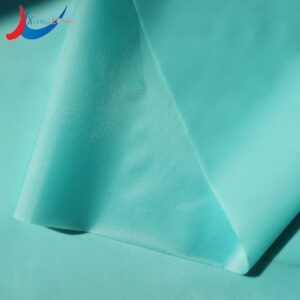
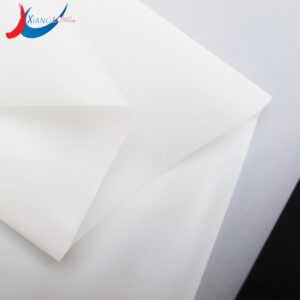
XL TPU Drop-Stitch Fabric is a 3D structural composite material developed for high-pressure inflatable systems that require both rigidity and portability.
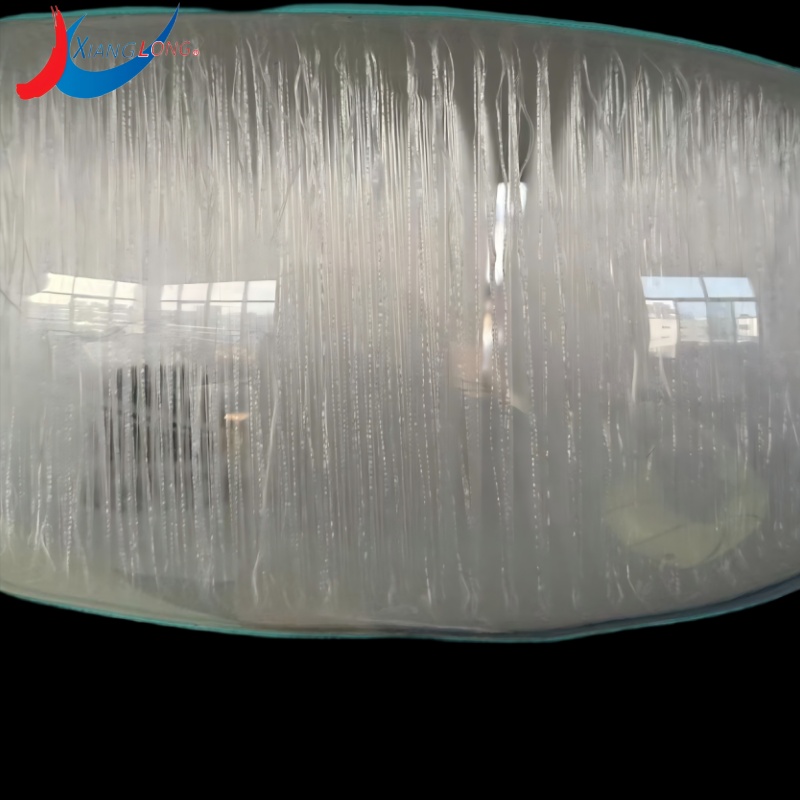
The construction consists of two layers of heavy-duty 500D polyester base fabric, internally connected by thousands of high-tenacity 840D polyester yarns. These vertical yarns form a dense internal network that precisely controls the distance between the top and bottom layers.
Once coated with a durable polyether-based TPU, the entire structure becomes fully sealed and airtight. When inflated to high pressure, the internal yarns are tensioned simultaneously, transforming the flexible material into a rigid, flat surface.
This unique structure allows manufacturers to create products that perform similarly to solid boards, while still maintaining the ability to deflate, fold, and transport with ease.
How Drop-Stitch Technology Works
The performance of this material is defined by its internal architecture.
Inside the fabric, thousands of evenly distributed yarns connect the upper and lower layers. These yarns act as structural supports that restrict expansion in thickness while allowing internal pressure to build.
When air pressure increases, each yarn becomes tensioned, distributing force evenly across the entire surface. This results in a stable, flat, and rigid structure that maintains its shape under load.
This principle is what enables inflatable products to achieve board-like stiffness, making drop stitch fabric essential for modern high-performance inflatable equipment.
High-Pressure Performance and Structural Rigidity
The ability to withstand high internal pressure is critical for this type of material.
The reinforced 500D polyester layers, combined with dense internal yarn connections, allow the fabric to operate at high PSI levels. This pressure is directly responsible for the rigidity and load-bearing capacity of the final product.
Under proper inflation, structures made from this high-pressure inflatable fabric can support significant weight while maintaining dimensional stability and surface flatness.
This makes it suitable for applications where both strength and precision are required.
Stability Compared to Traditional Inflatable Materials
Conventional inflatable materials tend to form rounded or unstable shapes when pressurized.
Drop stitch construction changes this behavior by locking the distance between layers. This results in:
Flat surfaces instead of curved shapes
Even load distribution across the structure
Reduced deformation under pressure
These characteristics allow designers to move beyond simple inflatable forms and create functional platforms, boards, and structural surfaces.
Portability Without Compromising Strength
Despite its rigid performance when inflated, the material retains the flexibility of a textile when deflated.
Once air is released, the structure collapses into a flat, foldable sheet that can be rolled and packed efficiently. This significantly reduces storage volume and simplifies transportation.
For outdoor equipment and mobile systems, this combination of rigidity and portability is a major advantage.
Durable and Waterproof Construction
The polyether-based TPU coating provides a continuous, airtight barrier across the material.
This coating enhances resistance to water exposure, hydrolysis, and abrasion, making the fabric suitable for long-term use in demanding environments. The sealed structure also ensures reliable air retention over extended periods.
Combined with the high-strength polyester base and internal yarn system, the material delivers long service life under repeated inflation and deflation cycles.