Why Standard Materials Fail in Oil Environments
In many industrial applications, material selection is often based on initial strength or basic waterproofing performance. However, when exposed to oils and hydrocarbons, many conventional materials begin to degrade in less obvious ways.
Common failure mechanisms include:
Swelling and softening when oils penetrate the material structure
Loss of tensile strength over time due to chemical interaction
Surface cracking or embrittlement after repeated exposure cycles
Delamination between coating and base fabric
These changes may not be immediately visible, but they significantly reduce the reliability of the material, especially in containment applications.
This is why oil resistance is not simply about surface protection—it is about maintaining performance over time.
Designed for Chemical Stability, Not Just Resistance
The TPU layer used in this fabric is formulated specifically for stability in hydrocarbon-rich environments.
Rather than acting as a temporary barrier, it is engineered to:
Resist absorption of oils and fuels
Maintain flexibility after repeated exposure
Prevent structural degradation at the molecular level
Retain sealing performance under long-term use
This distinction is critical in applications where materials remain in contact with fluids for extended periods.
Structural Strength for High-Stress Industrial Use
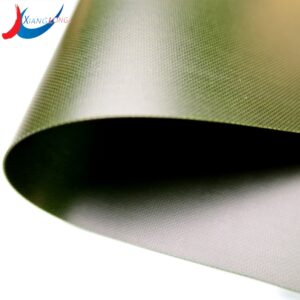
The 2520D polyester base provides a level of mechanical strength that goes beyond typical industrial fabrics.
This high-denier construction contributes to:
Exceptional resistance to punctures and sharp objects
Stability under heavy loads and pressure
Resistance to abrasion in rough environments
Long-term durability under continuous use
In applications such as spill containment or fuel storage, the material must not only resist chemicals but also support the physical weight and movement of liquids.
Containment Integrity as a System Requirement
In industrial settings, containment is not a localised function—it is a system-level requirement.
A single weak point can compromise the entire structure.
This fabric supports high-frequency (HF) and radio-frequency (RF) welding, enabling:
Seamless, continuous bonding
Elimination of needle holes and leak paths
Consistent sealing across large surface areas
High-strength joints capable of handling stress and pressure
This makes it suitable for applications where even minor leakage is unacceptable.
Maintaining Flexibility Under Harsh Conditions
One of the less obvious challenges in chemical environments is maintaining material flexibility.
Many materials become stiff, brittle, or prone to cracking after repeated exposure to oils and industrial fluids.
This fabric is designed to remain pliable, allowing it to:
Withstand repeated folding and deployment
Adapt to irregular shapes and surfaces
Maintain performance in dynamic environments
This is particularly important for flexible containment systems and portable equipment.
Performance in Long-Term Industrial Deployment
In real-world applications, materials are rarely used once—they are deployed, stored, reused, and exposed to varying conditions over time.
This fabric is engineered for:
Repeated exposure to oils and chemicals
Long-term outdoor or indoor use
Continuous mechanical stress
Environmental fluctuations
Its durability reduces the need for frequent replacement, making it a practical choice for industrial operations focused on reliability and cost control.
Material Structure Overview
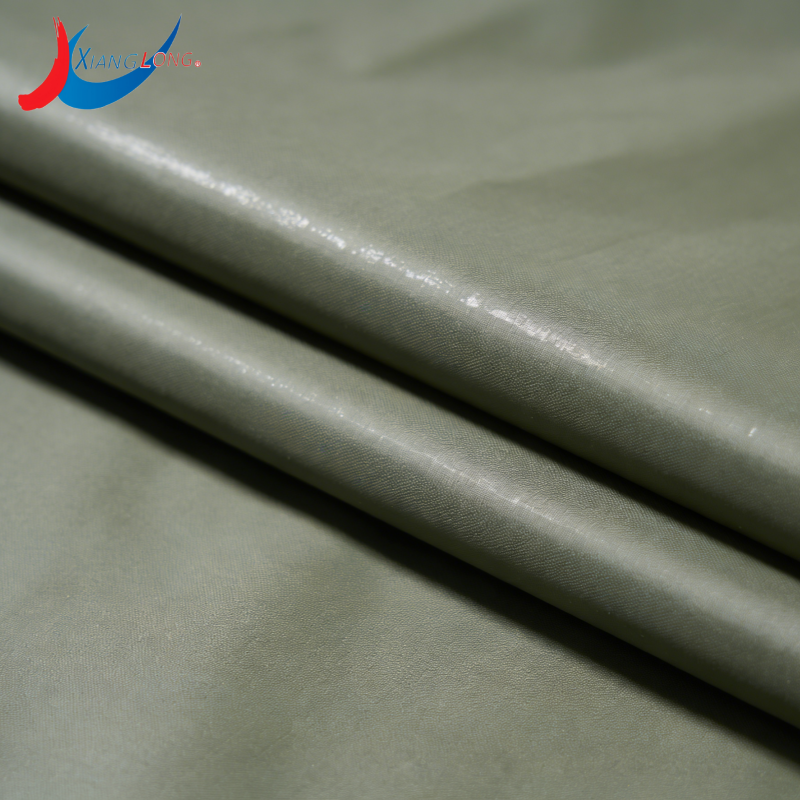
2520D polyester base provides extreme mechanical strength
Oil-resistant TPU coating ensures chemical stability and impermeability
Composite construction balances flexibility with structural performance
The structure is optimised for industrial containment and protection rather than general-purpose applications.