








One of the first questions manufacturers ask when sourcing TPU coated fabric is surprisingly simple:
“How much pressure can your TPU fabric withstand?”
It sounds like a straightforward technical question, yet it has no straightforward answer.
Material suppliers receive similar inquiries almost every day.
“Can this fabric hold 3 bar?”
“Is 420D TPU stronger than 210D?”
“Will a thicker TPU coating allow higher pressure?”
“What is the maximum PSI for your TPU fabric?”
These questions are understandable because pressure is often used as a quick way to compare inflatable products. Unfortunately, using pressure as the only benchmark for selecting a fabric can easily lead to incorrect engineering decisions.
Unlike steel pipes or aluminum pressure vessels, coated fabrics are flexible materials. Once they are transformed into an inflatable product, their performance depends on much more than the material itself. Product geometry, chamber dimensions, welding quality, reinforcement design, safety factors and operating conditions all work together to determine how much internal pressure the finished product can safely withstand.
This explains why two products manufactured from exactly the same TPU coated nylon fabric can have completely different working pressures.
A small cylindrical air bladder may safely operate at several times the pressure of a large inflatable platform, even though both are produced using identical fabric specifications. The difference is not caused by the material. It is created by engineering.
For this reason, experienced product designers rarely begin a development project by asking how much pressure a fabric can hold.
Instead, they ask a different question.
How will this material perform within the complete inflatable system?
That approach produces better products, more reliable manufacturing and fewer failures in the field.
This article explains why pressure capacity cannot be defined by fabric specifications alone and examines the engineering factors that truly determine the performance of inflatable TPU products.
Pressure Is a System Performance, Not a Fabric Property
When purchasing TPU coated fabric, many buyers naturally compare specification sheets.
Typical parameters include:
- Fabric denier
- Total thickness
- TPU coating weight
- Tensile strength
- Tear strength
- Adhesion strength
- Weight per square meter
These values are essential because they describe the mechanical capability of the composite material. However, they only describe the material itself.
They do not describe the finished product.
This distinction is often overlooked during the early stages of product development.
Imagine receiving two samples of exactly the same TPU coated nylon fabric.
Both samples have identical laboratory data.
Both pass the same tensile and tear resistance tests.
Both are manufactured using the same coating process.
If one sample is used to manufacture a compact medical air bladder while the other becomes a large inflatable floating dock, would both products operate at the same pressure?
The answer is obviously no.
Although the material remains identical, the stress distribution throughout the finished structure changes completely.
This is why experienced engineers avoid assigning a fixed pressure value to a fabric without understanding the intended application.
The material provides the foundation, but engineering determines the result.
A useful way to think about TPU coated fabric is to compare it with reinforced concrete.
Concrete has known compressive strength, yet engineers never determine how much weight a bridge can support by looking only at the concrete specification.
They also calculate beam dimensions, reinforcement layout, span length, safety factors and expected loading conditions.
Inflatable structures follow exactly the same principle.
The fabric is only one component of a much larger engineering system.
Product Geometry Changes Everything
Among all the variables affecting inflatable products, geometry is often the least understood by buyers and the most important for engineers.
Shape determines how internal air pressure is converted into mechanical stress.
A long cylindrical tube distributes pressure very differently from a flat inflatable cushion.
A spherical bladder behaves differently from a rectangular air mattress.
A narrow inflatable beam experiences different stress compared with a large floating platform.
Even when internal pressure remains identical, the force acting on the fabric may vary dramatically simply because the geometry changes.
This explains why some inflatable products can safely operate at relatively high pressure while others must remain at much lower levels despite using stronger materials.
For example, consider two products manufactured from the same 420D TPU coated nylon fabric.
The first product is a compact inflatable support tube used inside industrial equipment.
Its diameter is relatively small, allowing internal pressure to be distributed evenly across the structure.
The second product is a large inflatable rescue platform measuring several meters in length.
Although both products use identical fabric and identical welding technology, the larger flat structure experiences significantly greater membrane stress over its surface.
If both products were inflated to exactly the same pressure, the larger structure would approach its engineering limits much sooner.
The difference has nothing to do with the quality of the fabric.
It is entirely related to structural design.
This principle is one of the reasons experienced inflatable product manufacturers always request product drawings before recommending a fabric specification.
Without knowing the geometry, recommending pressure performance is largely guesswork.
Bigger Isn’t Always Better
Many people assume that increasing product size automatically improves performance.
For inflatable systems, the opposite is often true.
As chamber dimensions increase, the total force generated by internal air pressure also increases.
This means larger products frequently require additional reinforcement, wider welding seams or modified structural layouts rather than simply selecting thicker fabric.
Consider an inflatable pillow and an inflatable gym mat.
Neither product experiences external pressure in exactly the same way.
The inflatable pillow supports relatively small loads over a compact surface area.
The gym mat spreads pressure across a much larger structure.
Although both may be produced from TPU coated fabric, the engineering solutions are completely different.
The same principle applies to rescue boats, inflatable tents, flexible storage tanks and medical pressure mattresses.
Increasing dimensions changes how forces travel throughout the structure.
For manufacturers, this means choosing fabric solely according to denier can easily result in overengineering or underengineering.
A carefully designed 420D system may outperform an unnecessarily heavy 840D construction if the geometry is optimized correctly.
Engineering efficiency is not about selecting the strongest material.
It is about selecting the most appropriate material for the intended structure.
Chamber Design Plays a Bigger Role Than Most Buyers Expect
When discussing inflatable products, many conversations focus entirely on the outer shell.
Engineers, however, often spend even more time discussing what happens inside the product.
The internal chamber design determines how pressure is distributed, how loads are transferred and how deformation is controlled during inflation.
A single large air chamber behaves very differently from multiple interconnected chambers.
Likewise, products with internal baffles, drop-stitch construction or partition walls respond differently under pressure than simple hollow structures.
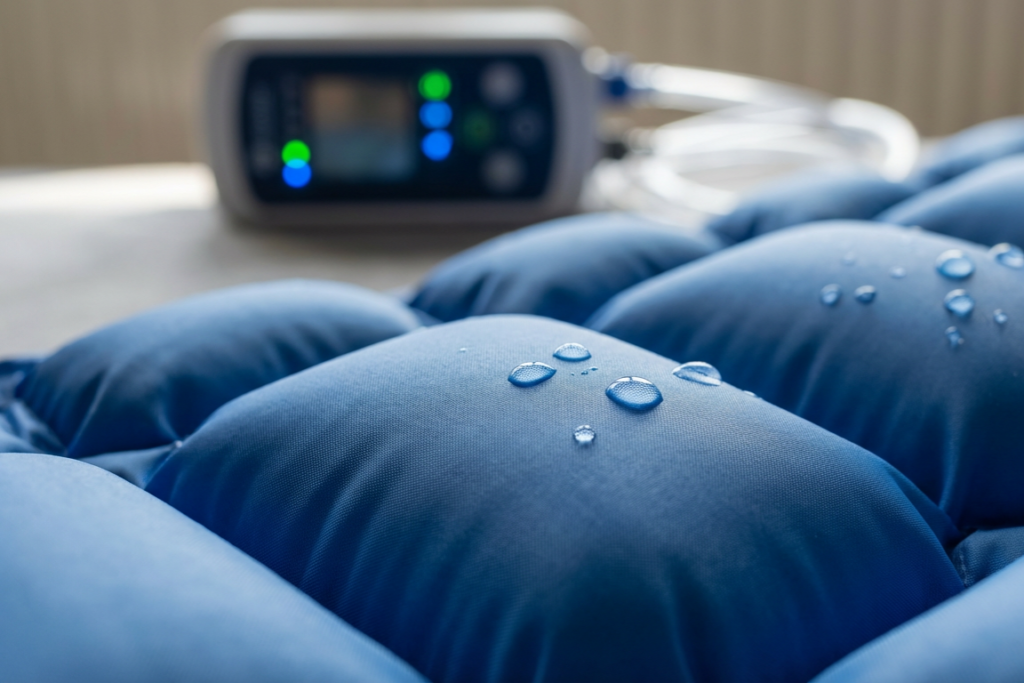
Take an anti-decubitus medical mattress as an example.
Although it operates at relatively low pressure compared with inflatable boats or industrial bladders, it contains dozens of independent air cells working together to distribute body weight evenly.
Each chamber supports only part of the total load.
This design reduces localized stress while improving comfort and reliability.
Now compare that with a portable water storage bladder.
The internal pressure may remain relatively modest, yet the continuously changing shape of the stored liquid creates dynamic loading conditions that differ entirely from those inside a medical mattress.
Neither product can be evaluated using pressure alone.
Their internal structures define how the fabric actually performs.
For manufacturers developing new inflatable products, chamber configuration should therefore be considered at the same stage as material selection rather than treated as an independent design decision.
Welding Quality Often Determines the Real Pressure Limit
One of the biggest misconceptions in the inflatable products industry is that fabric failure always occurs before seam failure.
In reality, properly manufactured TPU coated fabrics are frequently stronger than the welded joints connecting them.
This means the maximum operating pressure of a finished product is often controlled by seam performance rather than fabric strength.
Whether a product uses heat welding, radio frequency welding or high-frequency welding, every welded joint becomes part of the pressure boundary.
Poor temperature control, inconsistent welding pressure, insufficient overlap width or contaminated surfaces can all reduce seam strength long before the fabric itself reaches its mechanical limit.
This is why two manufacturers using identical TPU fabric can produce products with very different durability and pressure performance.
The material is the same.
The manufacturing process is not.
Experienced engineers therefore evaluate welded seams with the same level of attention given to fabric specifications.
A premium coated fabric cannot compensate for poor welding practices, just as excellent welding cannot overcome an unsuitable material selection.
Reliable inflatable products are created only when both elements work together as part of a complete engineering system.
Material Construction Still Matters—Just Not in Isolation
Saying that fabric specifications alone cannot determine pressure capacity does not mean the material is unimportant. On the contrary, selecting the appropriate TPU coated fabric remains one of the most critical decisions during product development. The difference is that material properties must always be evaluated alongside product design.
The woven reinforcement fabric is responsible for carrying the tensile loads generated during inflation. The TPU coating provides airtight performance, flexibility and weldability. Together, they form a composite structure, and every layer contributes to the final result.
One question buyers frequently ask is whether moving from 210D nylon to 420D or even 840D nylon will automatically increase the working pressure of the product.
The answer is not necessarily.
Higher-denier fabrics generally provide greater tensile strength and improved resistance to puncture and abrasion. However, they also increase weight, reduce flexibility and may require adjustments to welding parameters or product design.
Choosing a heavier fabric simply because it appears stronger can create unnecessary compromises. A hydration reservoir, for example, benefits from lightweight construction and repeated folding performance. Specifying an 840D fabric for such a product would add weight without delivering meaningful performance improvements.
On the other hand, inflatable rescue boats, industrial lifting bags and floating platforms are exposed to far greater mechanical loads. These products often justify heavier reinforcement because durability under demanding conditions is a priority.
The goal is never to select the strongest fabric available. The goal is to select the fabric that matches the engineering requirements of the finished product.
The TPU coating itself also deserves careful consideration.
A thicker coating may improve abrasion resistance and provide additional material for stronger welded seams, but excessive coating thickness can increase stiffness and overall product weight. In many applications, finding the right balance between flexibility, durability and manufacturing efficiency produces better results than simply increasing coating thickness.
Every Inflatable Product Has Its Own Engineering Priorities
Looking across different industries quickly reveals why assigning a universal pressure rating to TPU fabric is unrealistic.
A medical air mattress is designed to redistribute pressure across dozens of independent air cells. Comfort, quiet operation and long-term reliability are far more important than operating at high internal pressure.
An inflatable kayak must withstand repeated impacts, abrasion against rocks and constant folding during transport. Here, toughness, puncture resistance and seam durability become the primary concerns.
A portable water storage bladder experiences changing loads as the liquid moves during filling, transport and discharge. The engineering challenge lies in managing dynamic forces rather than simply increasing burst pressure.
Inflatable lifting bags represent another completely different category. Their structural design, reinforcement strategy and safety requirements are dictated by heavy industrial loads, meaning every aspect of the construction is engineered around controlled deformation and predictable performance.
Although all of these products may incorporate TPU coated fabrics, their design objectives are fundamentally different.
The fabric is one part of the solution, not the solution itself.
A Practical Example
Consider the following situation.
A manufacturer contacts two different fabric suppliers looking for material recommendations.
The only question provided is:
“We need a TPU coated nylon fabric capable of handling 5 bar.”
At first glance, the request appears clear.
However, several essential pieces of information are missing.
Is the product cylindrical or flat?
What are its overall dimensions?
Will it contain air, water or another medium?
How frequently will it be folded?
Will it be used indoors, outdoors or in marine environments?
What welding process will be employed during manufacturing?
Without these answers, recommending a fabric becomes little more than speculation.
Now imagine the same project beginning differently.
Instead of asking for a pressure rating, the manufacturer provides engineering information including product drawings, chamber dimensions, intended operating pressure, burst pressure requirements, expected service life and environmental conditions.
The conversation immediately changes.
Material selection becomes an engineering discussion rather than a comparison of catalogue specifications.
This approach not only leads to a more suitable fabric choice but also reduces development time, minimizes production risks and improves long-term product reliability.
Questions Engineers Ask Before Recommending TPU Fabric
Experienced material engineers rarely begin with the question, “What pressure does the customer want?”
Instead, they build a complete understanding of the product.
Typical questions include:
- What type of inflatable product is being developed?
- What is the overall size of the air chamber?
- What is the normal working pressure?
- What burst pressure is required?
- How will the product be welded?
- How often will it be folded during its service life?
- Will it be exposed to UV radiation, salt water, chemicals or low temperatures?
- Is lightweight construction or maximum durability the higher priority?
- Are there regulatory requirements such as food-contact, medical or flame-retardant standards?
Answers to these questions allow engineers to recommend an appropriate combination of base fabric, TPU formulation, coating thickness and manufacturing process.
This engineering-first approach consistently delivers better results than selecting a material based solely on pressure targets.
Common Misconceptions About TPU Fabric Pressure
| Common Question | Engineering Perspective |
|---|---|
| How many PSI can this TPU fabric withstand? | Pressure depends on the complete product design, not the fabric alone. |
| Will a thicker TPU coating always increase pressure capacity? | Not necessarily. It may improve seam performance or abrasion resistance, but product geometry remains the dominant factor. |
| Is 840D always better than 420D? | Only if the application requires higher structural strength. Extra weight is not always beneficial. |
| If the fabric tensile strength is higher, will the inflatable product automatically become stronger? | No. Weld quality, chamber layout and structural design often determine overall performance. |
| Can two products made from the same TPU fabric operate at different pressures? | Yes. Product shape, size and internal construction can create completely different stress distributions. |
These misconceptions are common because specification sheets provide measurable data while engineering performance depends on how those materials are applied.
The most successful inflatable products are not created by selecting the fabric with the highest numbers. They are created by combining suitable materials with sound engineering principles.
Pressure Performance Begins with Product Design
There is no universal pressure rating for TPU coated fabric, and there never will be.
A fabric specification describes the capabilities of the material itself, but it does not define how an inflatable product will perform after it has been transformed into a finished structure.
Pressure capacity is the result of multiple engineering decisions working together. Product geometry, chamber dimensions, reinforcement strategy, welding quality, TPU construction, manufacturing consistency and safety factors all contribute to the final performance.
This is why experienced manufacturers discuss product design before recommending a fabric. They understand that selecting the right material is only one step in developing a reliable inflatable system.
For brands producing inflatable boats, medical air mattresses, portable water reservoirs, rescue equipment or industrial air bladders, the objective should never be to find a fabric with the highest theoretical pressure rating. The objective is to build a product that performs safely and consistently throughout its entire service life.
When viewed from that perspective, the most valuable question is no longer “How much pressure can this TPU fabric withstand?”
Instead, it becomes:
“Which TPU fabric and engineering solution will allow this product to achieve its required pressure safely, efficiently and reliably?”
That shift in thinking marks the difference between selecting a material and engineering a successful inflatable product.