

Şişme bir kanoda kullanılan malzeme, sadece görünüşünden çok daha fazlasını etkiler. Teknenin havayı ne kadar iyi tuttuğunu, depolama için ne kadar kolay katlandığını, kullanıcıların taşıması gereken ağırlığı ve yapının su, ekipman ve pürüzlü yüzeylerle tekrarlanan temasına nasıl tepki verdiğini belirler.
Üreticiler için karar genellikle kumaşın mukavemeti, esnekliği, hava geçirmezliği ve üretim gereksinimleri arasında uygun bir denge bulmaktır. TPU kaplamalı naylon, dokuma bir tekstil tabanı ile termoplastik poliüretan bir kaplamayı bir araya getirdiği için şişme ürünlerde kullanılan malzeme seçeneklerinden biridir. Naylon yapısal destek sağlarken, TPU katmanı hava tutma özelliğine katkıda bulunur ve uyumlu kaynak işlemlerine olanak tanır.
Ancak her şişme kano için uygun tek bir kumaş özellikleri yoktur. Hafif rekreasyonel bir modelin, turistik bir kano veya daha zorlu su koşullarına yönelik bir modelden farklı gereksinimleri vardır. Kumaş denierı, kaplama yapısı, kalınlık ve dikiş tasarımı gibi tüm faktörler bitmiş ürünle ilişkili olarak değerlendirilmelidir.
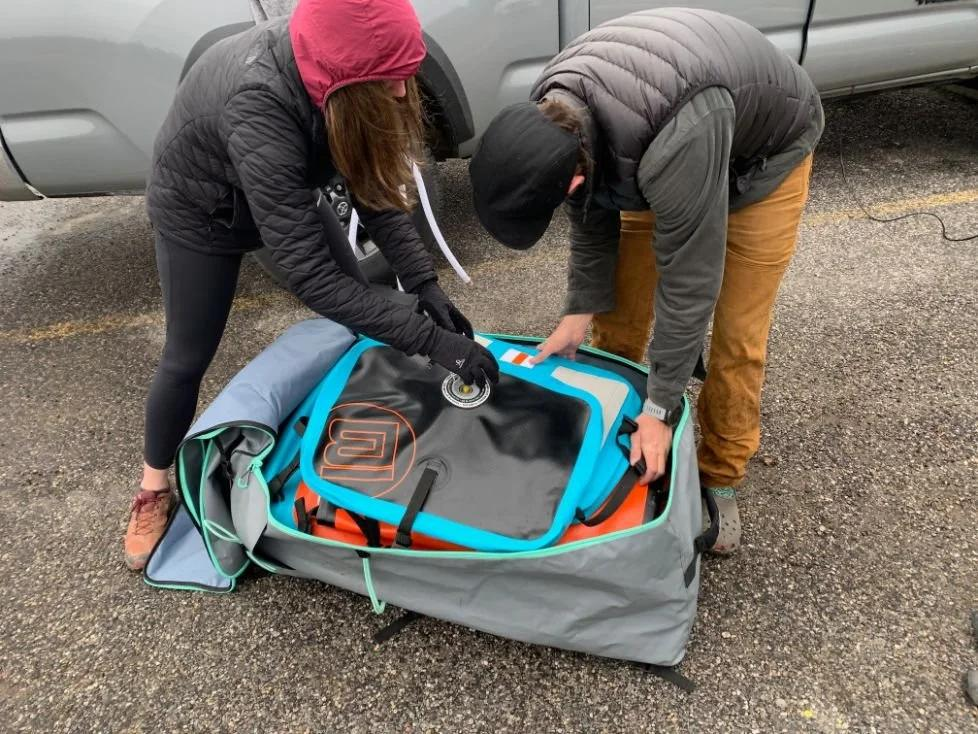
Şişme Kanolar Hangi Malzemelerden Yapılır?
Şişme kanolar genellikle kaplamalı tekstil malzemeler kullanılarak üretilir. Kumaş, katlanabilir, taşınabilir ve düzenli kullanım için yeterince esnek olmakla birlikte hava geçirmez bir yapı oluşturmalıdır.
PVC kaplamalı kumaşlar ve TPU kaplamalı kumaşlar, şişme ürün imalatında bulunan iki malzeme seçeneğidir. Her ikisi de uygun yapılar içinde kullanılabilir, ancak malzeme özellikleri ve işleme gereksinimleri farklılık gösterir.
PVC Kaplamalı Kumaş
PVC kaplamalı kumaş, şişme ürünlerde uzun yıllardır kullanılmaktadır. Su direnci sağlamak ve uyumlu birleştirme yöntemleriyle işlenebilen bir yüzey sunmak için bir tekstil tabanı ile polivinil klorür kaplamasını bir araya getirir.
Üreticiler için PVC, malzeme maliyeti, mevcut üretim ekipmanları ve köklü üretim süreçleri önemli faktörler olduğunda değerlendirilebilir. Uygunluğu, spesifik formülasyona, kumaş yapısına ve hedeflenen hizmet koşullarına bağlıdır.
Bir husus, malzemenin tekrarlanan katlama ve depolama sırasında nasıl davrandığıdır. Bazı PVC yapılar, belirli çevresel koşullara uzun süre maruz kaldığında esnekliğini kaybedebilir. Gerçek sonuç formülasyona ve ürün tasarımına bağlı olduğundan, üreticiler malzemeyi ilgili yaşlandırma ve katlama testleriyle değerlendirmelidir.
TPU Kaplamalı Naylon
TPU kaplamalı naylon, dokuma bir naylon alt tabanı ile termoplastik poliüretan bir kaplamayı bir araya getirir. Bu iki katman farklı işlevler görür.
Naylon taban, gerilme mukavemeti ve yırtılma direncine katkıda bulunur. TPU kaplama ise hava geçirmez bir yapıyı destekleyen esnek bir bariyer sağlar ve uygun ısıyla kaynatma veya yüksek frekanslı kaynak süreçleriyle birleştirilebilir.
Şişme kanolar için, bu kombinasyon; ürünün mekanik mukavemet, esneklik ve hava tutma dengesine ihtiyaç duyduğu durumlarda değerlendirilmeye değerdir.
TPU kaplamalı naylon farklı kumaş yapılarında mevcuttur. Üreticiler, gerekli ağırlık, mekanik özellikler ve bileşen tasarımı doğrultusunda 210D ve 420D naylonu karşılaştırabilir. Denier değeri tek başına nihai performansı belirlemez.
Şişme Kanolar İçin TPU vs PVC Kumaş
TPU ile PVC arasındaki seçim, bir malzemenin her zaman daha iyi olduğu yönündeki genel bir varsayımdan ziyade, bitmiş kano'nun gereksinimlerine dayanmalıdır.
Her iki malzemenin de farklı formülasyon ve yapıları vardır. Performansları, tekstil tabanına, kaplama kalınlığına, katkı maddelerine, üretim sürecine ve çevresel maruziyete göre değişebilir.
| Değerlendirme Faktörü | TPU Kaplamalı Naylon | PVC Kaplamalı Kumaş |
|---|---|---|
| Tekstil Tabanı | Genellikle dokuma naylon | Polyester veya diğer tekstil tabanları |
| Esneklik | TPU formülasyonuna ve yapısına bağlıdır | PVC formülasyonuna ve plastikleştirici sistemine bağlıdır |
| Hava geçirmezlik | Uygun hava bariyeri performansı sağlayabilir | Uygun hava bariyeri performansı sağlayabilir |
| Birleştirme Yöntemleri | Uygun HF kaynak ve ısıyla kaynatma ile uyumlu | Uygun kaynak süreçleriyle uyumlu |
| Katlama Davranışı | Tekrarlanan katlamalar altında değerlendirilmesi gerekir | Tekrarlanan katlamalar altında değerlendirilmesi gerekir |
| Malzeme seçimi | Sıklıkla esnek teknik şişmeler için düşünülür | Köklü PVC işleme ve maliyet önceliği olan yerlerde sıklıkla değerlendirilir |
Esneklik ve Tekrarlanan Katlama
Şişme kanolar kullanımı sonrası sıkça havası boşaltılır. Kumaşları bir saklama çantasına katlanabilir, bir araçta taşınabilir ve bir sonraki yolculuk için yeniden açılabilir.
Bu süreçte kaplamanın tekstil tabanına bağlı kalması gerekir. Tekrarlanan bükülmeler kaplamaya ve iki katman arasındaki ara yüze baskı uygulayabilir.
TPU kaplamalı naylon, katlama sırasında esnekliğin önemli olduğu ürünler için sıklıkla değerlendirilir. Ancak sonuç, TPU formülasyonuna, kaplama kalınlığına ve kumaş yapısına bağlıdır.
Üreticiler, gerçek numuneleri tekrarlanan katlama döngüleriyle test etmelidir. Testten sonra malzeme yüzey çatlakları, kaplama ayrılması ve hava geçirmezlik performansındaki değişimler açısından incelenmelidir.
Hava Geçirmezlik ve Dikiş Yapısı
Kaplamalı kumaş, yüzeyinden hava geçişini sınırlamalıdır. Aynı zamanda dikişler ve valf bağlantıları güvenilir bir sızdırmazlığı korumalıdır.
TPU, termoplastik özelliklere sahip olduğundan, uygun TPU kaplamalı kumaşlar yüksek frekanslı kaynak ve ısıyla kaynatma ile uyumlu hale gelir. Bu işlemler, geleneksel iğne dikişine güvenmeden sızdırmaz eklemeler oluşturabilir.
Bitmiş dikişin kalitesi yine de malzeme uyumuna, eklem tasarımına, ekipman ayarlarına ve operatör kontrolüne bağlıdır. Ne TPU ne de PVC otomatik olarak sızdırmayan bir kano garanti eder.
Çevresel Maruziyet
Şişme kanolar su, güneş ışığı, nem ve sıcaklık değişimlerinin bulunduğu ortamlarda kullanılır. Malzeme seçimi beklenen koşulları yansıtmalıdır.
Hidroliz direnci önemli olduğunda, özellikle uzun süreli nem maruziyeti olan ürünler için polieter temelli TPU sıklıkla değerlendirilir. Ancak üreticiler, her TPU kaplamasının aynı düzeyde direnç sunduğunu varsaymak yerine spesifik formülasyonu ve mevcut test verilerini incelemelidir.
Sık dış mekan kullanımına yönelik ürünler için, çevresel yaşlandırma testleri kaplama ve tekstil yapısının gerekli özellikleri koruyup korumadığını değerlendirmeye yardımcı olabilir.
Şişme Kano İçin 210D mi Yoksa 420D mi TPU Kaplamalı Naylon Daha İyidir?
Denier, naylon kumaşları karşılaştırırken önemli bir spesifikasyondur. İpliğin lineer kütlesini ifade eder. Yüksek bir denier genellikle daha ağır bir iplik anlamına gelir, ancak bitmiş kumaşın her uygulamada daha iyi performans göstereceğini otomatik olarak gerektirmez.
Şişme kano geliştirme için, 210D ve 420D TPU kaplamalı naylon karşılaştırılması gereken iki yapıdır. Uygunlukları hedef ürün ağırlığına, mekanik gereksinimlere, kaplama yapısına ve üretim sürecine bağlıdır.
Ağırlık Bilincine Sahip Tasarımlar İçin 210D TPU Kaplamalı Naylon
210D TPU-coated nylon may be considered when the product team needs to control fabric weight while maintaining the required structural performance.
A lighter textile construction can help reduce the material contribution to the finished kayak’s total weight. This is relevant to recreational models that users need to carry between a vehicle, storage area, and launch point.
However, lightweight construction should not come at the expense of required strength. Manufacturers need to evaluate tensile strength, tear resistance, coating adhesion, and the behavior of welded seams.
Xianglong’s XL TPU Kaplamalı 210D Naylon uses a 210D nylon base with a TPU coating. Its published product information lists a single-sided TPU coating thickness of 0.15 mm and a total fabric weight of 300 ± 15 g/m². These specifications provide a reference for initial comparison, but the suitability of the material for a particular kayak still needs to be confirmed through sample testing.
420D TPU Coated Nylon for More Demanding Construction Requirements
420D TPU-coated nylon provides a heavier textile construction that manufacturers may evaluate when a project requires a different balance of strength, abrasion resistance, and weight.
It may be considered for selected kayak components or products expected to experience more demanding handling conditions. Whether it is appropriate for the entire kayak depends on the design and the test results.
Xianglong’s XL TPU Kaplamalı 420D Naylon has a published single-sided TPU coating thickness of 0.15 mm and a total fabric weight of 375 ± 20 g/m² in its product specification sheet. The listed base fabric is 420D nylon.
When comparing this construction with 210D, manufacturers should look at the complete specification rather than assuming that the higher denier will automatically provide the required performance.
How Should the Two Options Be Compared?
The product team should compare both materials using the same evaluation criteria.
Important measurements include:
- Total fabric weight and thickness
- Tensile strength in warp and weft directions
- Yapışma gücü
- Aşınma direnci
- Kaplama yapışması
- Air permeability
- Flexibility after repeated folding
- Welded seam strength and leakage performance
The results should be considered alongside the kayak’s intended use. A material that meets the requirements for a recreational lake kayak may not be suitable for a product designed for frequent contact with rocky riverbanks.
Which Parts of an Inflatable Kayak Need Stronger Fabric?
An inflatable kayak is made up of several components, and each component experiences different forces. The main air chambers, floor, seat area, and attachment points should not automatically be treated as having identical material requirements.
A product design that accounts for these differences can help control material weight while maintaining the required performance.
Side Chambers and Main Air Tubes
The side chambers maintain the kayak’s inflatable structure. They need to hold air, retain their intended shape, and withstand the loads created during use.
Material selection should consider air retention, tensile strength, coating adhesion, and seam construction.
The geometry of the chambers also matters. Curved panels, end sections, and long welded joints may create different production conditions. Manufacturers should process representative samples using the intended equipment before approving the material.
Floor Panels
The floor is exposed to a different set of conditions. Users may sit, move equipment, or place bags and other items on its surface. During launching and landing, the underside may also contact sand, gravel, and rough ground.
Depending on the product design, manufacturers may evaluate a more substantial fabric construction for the floor than for the side chambers.
A 420D TPU-coated nylon construction may be worth testing for selected floor designs. Heavier options may also be considered where the expected abrasion and mechanical loads justify the additional material weight.
The final decision should be supported by abrasion, puncture, tear, and finished-product tests.
Seat Supports and Attachment Points
Handles, seat supports, footrests, and accessory attachment points can concentrate loads in relatively small areas.
Adding a reinforcement panel may help distribute these loads, but its shape and joining method are equally important. A poorly designed reinforcement can move stress toward the edge of the added panel instead of reducing it.
Manufacturers should test the complete attachment structure through suitable pull or repeated-load tests. The surrounding fabric and welded joints should be inspected for deformation or separation.
What Makes Airtight TPU Fabric Suitable for Inflatable Kayaks?
Airtightness is one of the most important material requirements for inflatable kayaks. The fabric needs to limit air loss through its surface, while the finished structure must maintain reliable seams and valve connections.
The performance of airtight TPU fabric depends on several related factors.
TPU Coating Thickness and Uniformity
Coating thickness affects the total fabric weight, flexibility, and barrier characteristics. A thicker coating is not automatically better because it may also change the material’s stiffness and processing behavior.
Uniform coating is important for consistent material performance. Variations in coating thickness or surface condition may affect both air retention and welding results.
Manufacturers should request coating specifications from the supplier and verify important properties through incoming inspection and testing.
Coating Adhesion
The TPU coating needs to remain bonded to the nylon base during folding, inflation, deflation, and normal handling.
If adhesion is insufficient, the coating may separate from the textile substrate. This can affect the material’s surface condition and long-term sealing performance.
Coating adhesion should be evaluated using an appropriate test method. For products expected to undergo repeated folding, testing after conditioning or mechanical cycling can provide additional information.
Air Permeability
Air permeability testing helps assess how much air passes through the fabric under defined conditions.
However, fabric-level testing is only one part of the evaluation. A finished kayak also contains welded seams, valves, and other connections that can affect pressure retention.
Manufacturers should therefore carry out both material tests and finished-product leakage checks. This helps distinguish a problem with the fabric itself from an issue related to assembly.
How Are TPU Fabrics Welded During Inflatable Kayak Production?
The joining process has a direct effect on the quality of the finished kayak. Even a suitable fabric can produce inconsistent results if the welding process is not properly matched to the material.
TPU-coated nylon can be processed using compatible high-frequency welding or heat-sealing equipment.
Yüksek Frekanslı Kaynak
High-frequency welding uses electromagnetic energy to generate heat within compatible thermoplastic materials. Pressure is applied during the process to create a bonded joint.
For inflatable kayak production, the method may be used for chamber seams and other suitable connections.
The welding result depends on several factors:
- TPU formulation and coating construction
- Fabric thickness and number of layers
- Electrode shape and contact area
- Welding time and applied pressure
- Equipment condition and process consistency
- Material positioning and surface cleanliness
Manufacturers should establish a suitable processing window through sample trials. The same parameters should not be assumed to work for every TPU-coated fabric.
Isıyla Kaynak
Heat sealing uses controlled temperature and pressure to join compatible thermoplastic surfaces.
The process needs to be adjusted to the specific fabric. Insufficient heat may result in incomplete bonding, while excessive heat can damage the coating or affect the textile base.
Production trials should examine the seam appearance, bonding strength, and air leakage. The results should be documented so that the process can be repeated consistently.
Why Seam Testing Matters
Airtight fabric does not guarantee airtight seams. Joint design, overlap width, welding conditions, and panel alignment all affect the finished connection.
Manufacturers should evaluate welded samples before moving into full prototype production.
Useful checks include peel strength, seam tensile strength, visual inspection, and leakage testing under defined pressure conditions. Representative kayak assemblies should also be tested because flat welded samples cannot reproduce every condition found in the finished product.
What Tests Should Be Completed Before an Inflatable Kayak Goes into Production?
Material approval should connect supplier specifications with actual manufacturing conditions. A fabric that looks suitable on paper may behave differently after cutting, welding, folding, and inflation.
A practical validation process should cover the material, the welded joints, and the finished kayak.
Fabric Inspection
Incoming material should be checked against the approved specification.
The inspection may include fabric weight, thickness, width, coating appearance, surface defects, and batch consistency. Where required, samples can be retained for comparison with later deliveries.
Mechanical Testing
Tensile strength and tear resistance provide information about how the fabric responds to mechanical loads. Abrasion and puncture tests may also be necessary depending on the kayak’s intended use.
The test methods should be agreed upon before material approval. Results from different methods should not be treated as directly comparable.
Folding and Inflation Cycles
Repeated folding and inflation can place stress on the coating and welded joints.
Manufacturers can develop a cycling test based on the expected product handling conditions. After the test, the fabric and seams should be inspected for coating damage, separation, deformation, and leakage.
Environmental Evaluation
Outdoor kayaks may be exposed to sunlight, moisture, and temperature changes during use and storage.
Where relevant, manufacturers may conduct UV exposure, humidity, hydrolysis, or temperature-aging tests. The selection of test conditions should reflect the intended market and expected service environment.
After conditioning, the material should be checked for changes in flexibility, adhesion, appearance, mechanical performance, and air retention.
Prototype Water Testing
A finished prototype should be evaluated under controlled water-use conditions before production approval.
The test plan may include pressure retention, load performance, stability, handling, and inspection of high-stress areas. Any abnormal pressure loss should be investigated to determine whether it comes from the fabric, a welded seam, a valve, or another component.
This step helps prevent material changes from being made when the actual issue lies elsewhere in the product structure.
How Can Manufacturers Keep Inflatable Kayak Material Costs Under Control?
Material cost is an important part of product development, but choosing the lowest-priced fabric does not always result in the lowest total production cost.
A fabric that is difficult to weld or produces inconsistent seams can increase scrap rates and labor requirements. A material that does not meet the expected service conditions may also increase warranty and replacement costs.
Product teams should evaluate the complete manufacturing impact.
Consider the Weight of the Finished Product
The weight of one fabric sample does not show the full impact on the finished kayak. Manufacturers need to calculate material consumption across all panels, reinforcements, and accessories.
A heavier fabric may be justified in a high-wear area but unnecessary in other components. Reviewing the material distribution can help avoid adding weight where it does not address a specific requirement.
Balance Material Cost and Production Yield
The fabric should be compatible with the cutting and welding process. Material consistency can affect panel alignment, seam appearance, and production yield.
During sample production, manufacturers should record processing parameters and identify any recurring defects. This information helps the team assess whether a material is suitable for regular production rather than just a single prototype.
Control Changes Between Material Batches
A change in fabric weight, coating thickness, or surface condition may affect welding performance.
Manufacturers should maintain an approved material specification and review any proposed supplier or construction changes before using them in production. Incoming inspection and batch records help identify differences before they affect finished kayaks.
Where Can Manufacturers Source TPU-Coated Nylon for Inflatable Kayaks?
Material sourcing should begin with the actual product requirements. Suppliers need information about the kayak type, target weight, component structure, expected operating conditions, and joining process before they can recommend suitable fabric constructions.
Xianglong Polymer Fabric provides TPU-coated nylon options for inflatable applications, including 210D and 420D constructions. These materials can be reviewed against the required fabric weight, mechanical properties, coating structure, and welding process.
The Airtight TPU Fabrics collection includes fabric options for inflatable boats, kayaks, and rescue rafts. Manufacturers can review the available constructions and compare them according to their product requirements.
For water-based applications, the Water Sports & Marine material range provides further information about TPU fabrics used in inflatable and marine equipment.
Before confirming an order, manufacturers should request the relevant technical data sheet and samples. The selected fabric should be processed using the intended production equipment and validated through mechanical, welding, and finished-product tests.
The best material for an inflatable kayak depends on how the finished product will be used. TPU-coated nylon is worth considering when manufacturers need a combination of textile strength, flexible construction, airtight performance, and compatibility with suitable welding processes.
A 210D construction may be evaluated for designs where weight is important, while 420D nylon may be considered when the product requires a different balance of strength and weight. The floor, side chambers, and reinforcement areas may also have different material requirements.
The final specification should be based on complete fabric data, sample processing, seam testing, and prototype evaluation. Comparing materials under the same conditions gives manufacturers a more reliable basis for product development and production approval.