

El material utilizado en un kayak hinchable afecta a mucho más que su apariencia. Determina cuán bien retiene el aire la embarcación, con qué facilidad se pliega para su almacenamiento, cuánto peso deben transportar los usuarios y cómo responde la estructura al contacto repetido con el agua, el equipo y superficies rugosas.
Para los fabricantes, la decisión suele reducirse a encontrar un equilibrio adecuado entre la resistencia del tejido, la flexibilidad, la estanqueidad al aire y los requisitos de producción. El nylon recubierto de TPU es una opción de material utilizada en productos hinchables porque combina una base textil tejida con un recubrimiento de poliuretano termoplástico. El nylon proporciona soporte estructural, mientras que la capa de TPU contribuye a la retención de aire y permite procesos de soldadura compatibles.
Sin embargo, no existe una única especificación de tejido que se adapte a todos los kayaks hinchables. Un modelo recreativo ligero tiene requisitos diferentes a los de un kayak de travesía o a los de un modelo destinado a condiciones acuáticas más exigentes. El denier del tejido, la construcción del recubrimiento, el grosor y el diseño de las costuras deben considerarse en relación con el producto final.
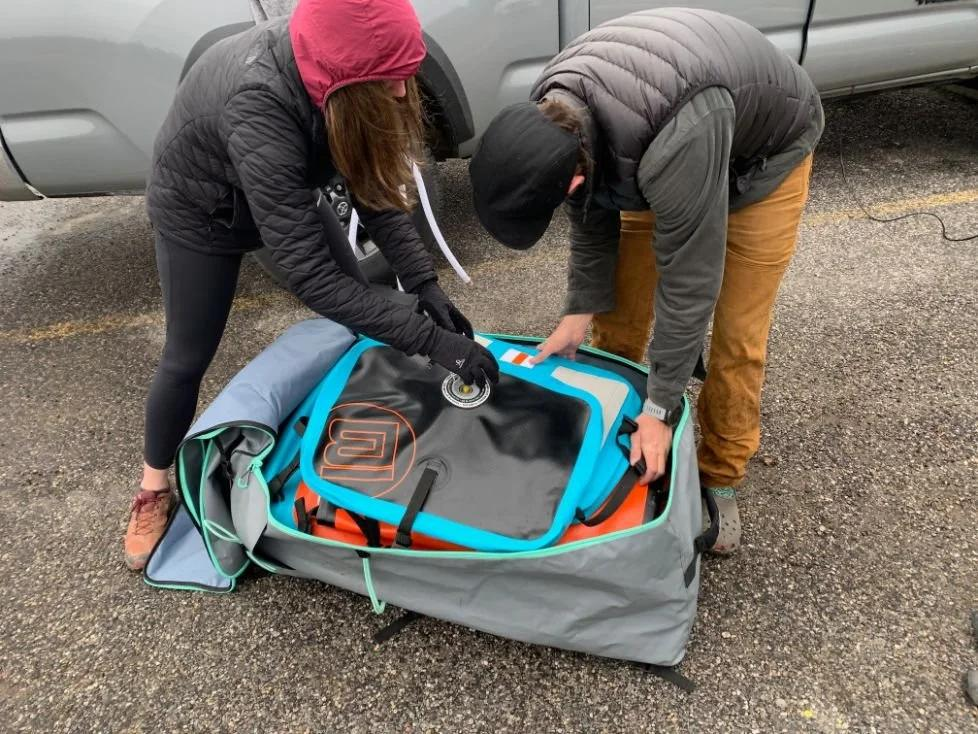
¿Qué materiales se utilizan para fabricar kayaks hinchables?
Los kayaks hinchables se fabrican comúnmente utilizando materiales textiles recubiertos. El tejido debe formar una estructura hermética al aire y, al mismo tiempo, mantener la suficiente flexibilidad para plegarse, transportarse y manipularse con regularidad.
Los tejidos recubiertos de PVC y los recubiertos de TPU son dos opciones de material presentes en la fabricación de productos hinchables. Ambos pueden emplearse en construcciones adecuadas, pero sus características materiales y requisitos de procesamiento difieren.
Tejido recubierto de PVC
El tejido recubierto de PVC se ha utilizado en productos hinchables durante muchos años. Combina una base textil con un recubrimiento de cloruro de polivinilo para ofrecer resistencia al agua y una superficie que puede procesarse mediante métodos de unión compatibles.
Para los fabricantes, el PVC puede considerarse cuando el costo del material, el equipo de producción existente y los procesos de fabricación establecidos son factores importantes. Su idoneidad depende de la formulación específica, la construcción del tejido y las condiciones de servicio previstas.
Una consideración es cómo se comporta el material durante el plegado y el almacenamiento repetidos. Algunas construcciones de PVC pueden volverse menos flexibles tras una exposición prolongada a determinadas condiciones ambientales. El resultado real depende de la formulación y del diseño del producto, por lo que los fabricantes deben evaluar el material mediante pruebas relevantes de envejecimiento y plegado.
Nylon recubierto de TPU
El nylon recubierto de TPU combina un sustrato de nylon tejido con un recubrimiento de poliuretano termoplástico. Las dos capas desempeñan funciones distintas.
La base de nylon aporta resistencia a la tracción y a la rotura. El recubrimiento de TPU proporciona una barrera flexible que respalda la construcción hermética al aire y puede unirse mediante procesos adecuados de sellado térmico o soldadura por alta frecuencia.
Para los kayaks hinchables, esta combinación merece ser evaluada cuando el producto requiere un equilibrio entre resistencia mecánica, flexibilidad y retención de aire.
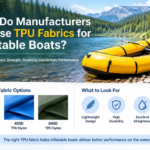
El nylon recubierto de TPU está disponible en diferentes construcciones de tejido. Los fabricantes pueden comparar el nylon 210D y el 420D según el peso requerido, las propiedades mecánicas y el diseño de los componentes. El valor del denier por sí solo no determina el rendimiento final.
Tela de TPU frente a PVC para kayaks hinchables
La elección entre TPU y PVC debe basarse en los requisitos del kayak terminado, en lugar de asumir de forma general que un material es siempre mejor.
Ambos materiales tienen formulaciones y construcciones diferentes. Su rendimiento puede variar según la base textil, el grosor del recubrimiento, los aditivos, el proceso de fabricación y la exposición ambiental.
| Factor de evaluación | Nylon recubierto de TPU | Tejido recubierto de PVC |
|---|---|---|
| Base textil | Nylon comúnmente tejido | Poliéster u otras bases textiles |
| Flexibilidad | Depende de la formulación y construcción del TPU | Depende de la formulación del PVC y del sistema plastificante |
| Estanqueidad | Puede proporcionar un rendimiento adecuado como barrera contra el aire | Puede proporcionar un rendimiento adecuado como barrera contra el aire |
| Métodos de unión | Compatible con soldadura HF y sellado térmico adecuados | Compatible con procesos de soldadura adecuados |
| Comportamiento al plegado | Requiere evaluación bajo plegado repetido | Requiere evaluación bajo plegado repetido |
| Selección del material | A menudo se considera para inflables técnicos flexibles | A menudo se considera donde el procesamiento establecido del PVC y el costo son prioritarios |
Flexibilidad y plegado repetido
Los kayaks hinchables suelen desinflarse después de su uso. Sus tejidos pueden plegarse en una bolsa de almacenamiento, transportarse en un vehículo y desplegarse nuevamente para el próximo viaje.
El recubrimiento debe permanecer adherido a la base textil durante este proceso. La flexión repetida puede ejercer tensión sobre el recubrimiento y la interfaz entre ambas capas.
El nylon recubierto de TPU suele considerarse para productos donde la flexibilidad durante el plegado es importante. Sin embargo, el resultado depende de la formulación del TPU, el grosor del recubrimiento y la construcción del tejido.
Los fabricantes deben probar muestras reales mediante ciclos repetidos de plegado. Tras las pruebas, el material debe inspeccionarse en busca de grietas en la superficie, separación del recubrimiento y cambios en el rendimiento hermético.
Estanqueidad y construcción de costuras
El tejido recubierto debe limitar la transmisión de aire a través de su superficie. Al mismo tiempo, las costuras y las conexiones de las válvulas deben mantener un sellado fiable.
El TPU posee propiedades termoplásticas que hacen que los tejidos recubiertos de TPU adecuados sean compatibles con la soldadura por alta frecuencia y el sellado térmico. Estos procesos pueden crear uniones selladas sin depender de la costura convencional con aguja.
La calidad de la costura terminada sigue dependiendo de la compatibilidad del material, el diseño de la unión, la configuración del equipo y el control del operador. Ni el TPU ni el PVC garantizan automáticamente un kayak libre de fugas.
Exposición ambiental
Los kayaks hinchables se utilizan en entornos que implican agua, luz solar, humedad y cambios de temperatura. La selección del material debe reflejar las condiciones esperadas.
El TPU a base de poliéter suele considerarse cuando la resistencia a la hidrólisis es importante, especialmente para productos expuestos a humedad prolongada. Sin embargo, los fabricantes deben revisar la formulación específica y los datos de prueba disponibles en lugar de asumir que todos los recubrimientos de TPU ofrecen el mismo nivel de resistencia.
Para productos destinados a un uso exterior frecuente, las pruebas de envejecimiento ambiental pueden ayudar a evaluar si el recubrimiento y la estructura textil conservan sus propiedades requeridas.
¿Es mejor el nylon recubierto de TPU 210D o 420D para un kayak hinchable?
El denier es una especificación importante al comparar tejidos de nylon. Describe la masa lineal del hilo. Un denier más alto generalmente indica un hilo más pesado, pero no significa automáticamente que el tejido terminado rinda mejor en cada aplicación.
Para el desarrollo de kayaks hinchables, el nylon recubierto de TPU 210D y 420D son dos construcciones que vale la pena comparar. Su idoneidad depende del peso objetivo del producto, los requisitos mecánicos, la estructura del recubrimiento y el proceso de fabricación.
Nylon recubierto de TPU 210D para diseños conscientes del peso
210D TPU-coated nylon may be considered when the product team needs to control fabric weight while maintaining the required structural performance.
A lighter textile construction can help reduce the material contribution to the finished kayak’s total weight. This is relevant to recreational models that users need to carry between a vehicle, storage area, and launch point.
However, lightweight construction should not come at the expense of required strength. Manufacturers need to evaluate tensile strength, tear resistance, coating adhesion, and the behavior of welded seams.
Xianglong’s Nylon 210D con revestimiento de TPU XL uses a 210D nylon base with a TPU coating. Its published product information lists a single-sided TPU coating thickness of 0.15 mm and a total fabric weight of 300 ± 15 g/m². These specifications provide a reference for initial comparison, but the suitability of the material for a particular kayak still needs to be confirmed through sample testing.
420D TPU Coated Nylon for More Demanding Construction Requirements
420D TPU-coated nylon provides a heavier textile construction that manufacturers may evaluate when a project requires a different balance of strength, abrasion resistance, and weight.
It may be considered for selected kayak components or products expected to experience more demanding handling conditions. Whether it is appropriate for the entire kayak depends on the design and the test results.
Xianglong’s XL Nylon 840D revestido con TPU has a published single-sided TPU coating thickness of 0.15 mm and a total fabric weight of 375 ± 20 g/m² in its product specification sheet. The listed base fabric is 420D nylon.
When comparing this construction with 210D, manufacturers should look at the complete specification rather than assuming that the higher denier will automatically provide the required performance.
How Should the Two Options Be Compared?
The product team should compare both materials using the same evaluation criteria.
Important measurements include:
- Total fabric weight and thickness
- Tensile strength in warp and weft directions
- Resistencia al desgarro
- Abrasion resistance
- Adherencia del recubrimiento
- Air permeability
- Flexibility after repeated folding
- Welded seam strength and leakage performance
The results should be considered alongside the kayak’s intended use. A material that meets the requirements for a recreational lake kayak may not be suitable for a product designed for frequent contact with rocky riverbanks.
Which Parts of an Inflatable Kayak Need Stronger Fabric?
An inflatable kayak is made up of several components, and each component experiences different forces. The main air chambers, floor, seat area, and attachment points should not automatically be treated as having identical material requirements.
A product design that accounts for these differences can help control material weight while maintaining the required performance.
Side Chambers and Main Air Tubes
The side chambers maintain the kayak’s inflatable structure. They need to hold air, retain their intended shape, and withstand the loads created during use.
Material selection should consider air retention, tensile strength, coating adhesion, and seam construction.
The geometry of the chambers also matters. Curved panels, end sections, and long welded joints may create different production conditions. Manufacturers should process representative samples using the intended equipment before approving the material.
Floor Panels
The floor is exposed to a different set of conditions. Users may sit, move equipment, or place bags and other items on its surface. During launching and landing, the underside may also contact sand, gravel, and rough ground.
Depending on the product design, manufacturers may evaluate a more substantial fabric construction for the floor than for the side chambers.
A 420D TPU-coated nylon construction may be worth testing for selected floor designs. Heavier options may also be considered where the expected abrasion and mechanical loads justify the additional material weight.
The final decision should be supported by abrasion, puncture, tear, and finished-product tests.
Seat Supports and Attachment Points
Handles, seat supports, footrests, and accessory attachment points can concentrate loads in relatively small areas.
Adding a reinforcement panel may help distribute these loads, but its shape and joining method are equally important. A poorly designed reinforcement can move stress toward the edge of the added panel instead of reducing it.
Manufacturers should test the complete attachment structure through suitable pull or repeated-load tests. The surrounding fabric and welded joints should be inspected for deformation or separation.
What Makes Airtight TPU Fabric Suitable for Inflatable Kayaks?
Airtightness is one of the most important material requirements for inflatable kayaks. The fabric needs to limit air loss through its surface, while the finished structure must maintain reliable seams and valve connections.
The performance of airtight TPU fabric depends on several related factors.
TPU Coating Thickness and Uniformity
Coating thickness affects the total fabric weight, flexibility, and barrier characteristics. A thicker coating is not automatically better because it may also change the material’s stiffness and processing behavior.
Uniform coating is important for consistent material performance. Variations in coating thickness or surface condition may affect both air retention and welding results.
Manufacturers should request coating specifications from the supplier and verify important properties through incoming inspection and testing.
Coating Adhesion
The TPU coating needs to remain bonded to the nylon base during folding, inflation, deflation, and normal handling.
If adhesion is insufficient, the coating may separate from the textile substrate. This can affect the material’s surface condition and long-term sealing performance.
Coating adhesion should be evaluated using an appropriate test method. For products expected to undergo repeated folding, testing after conditioning or mechanical cycling can provide additional information.
Air Permeability
Air permeability testing helps assess how much air passes through the fabric under defined conditions.
However, fabric-level testing is only one part of the evaluation. A finished kayak also contains welded seams, valves, and other connections that can affect pressure retention.
Manufacturers should therefore carry out both material tests and finished-product leakage checks. This helps distinguish a problem with the fabric itself from an issue related to assembly.
How Are TPU Fabrics Welded During Inflatable Kayak Production?
The joining process has a direct effect on the quality of the finished kayak. Even a suitable fabric can produce inconsistent results if the welding process is not properly matched to the material.
TPU-coated nylon can be processed using compatible high-frequency welding or heat-sealing equipment.
Soldadura por alta frecuencia
High-frequency welding uses electromagnetic energy to generate heat within compatible thermoplastic materials. Pressure is applied during the process to create a bonded joint.
For inflatable kayak production, the method may be used for chamber seams and other suitable connections.
The welding result depends on several factors:
- TPU formulation and coating construction
- Fabric thickness and number of layers
- Electrode shape and contact area
- Welding time and applied pressure
- Equipment condition and process consistency
- Material positioning and surface cleanliness
Manufacturers should establish a suitable processing window through sample trials. The same parameters should not be assumed to work for every TPU-coated fabric.
Termosellado
Heat sealing uses controlled temperature and pressure to join compatible thermoplastic surfaces.
The process needs to be adjusted to the specific fabric. Insufficient heat may result in incomplete bonding, while excessive heat can damage the coating or affect the textile base.
Production trials should examine the seam appearance, bonding strength, and air leakage. The results should be documented so that the process can be repeated consistently.
Why Seam Testing Matters
Airtight fabric does not guarantee airtight seams. Joint design, overlap width, welding conditions, and panel alignment all affect the finished connection.
Manufacturers should evaluate welded samples before moving into full prototype production.
Useful checks include peel strength, seam tensile strength, visual inspection, and leakage testing under defined pressure conditions. Representative kayak assemblies should also be tested because flat welded samples cannot reproduce every condition found in the finished product.
What Tests Should Be Completed Before an Inflatable Kayak Goes into Production?
Material approval should connect supplier specifications with actual manufacturing conditions. A fabric that looks suitable on paper may behave differently after cutting, welding, folding, and inflation.
A practical validation process should cover the material, the welded joints, and the finished kayak.
Fabric Inspection
Incoming material should be checked against the approved specification.
The inspection may include fabric weight, thickness, width, coating appearance, surface defects, and batch consistency. Where required, samples can be retained for comparison with later deliveries.
Mechanical Testing
Tensile strength and tear resistance provide information about how the fabric responds to mechanical loads. Abrasion and puncture tests may also be necessary depending on the kayak’s intended use.
The test methods should be agreed upon before material approval. Results from different methods should not be treated as directly comparable.
Folding and Inflation Cycles
Repeated folding and inflation can place stress on the coating and welded joints.
Manufacturers can develop a cycling test based on the expected product handling conditions. After the test, the fabric and seams should be inspected for coating damage, separation, deformation, and leakage.
Environmental Evaluation
Outdoor kayaks may be exposed to sunlight, moisture, and temperature changes during use and storage.
Where relevant, manufacturers may conduct UV exposure, humidity, hydrolysis, or temperature-aging tests. The selection of test conditions should reflect the intended market and expected service environment.
After conditioning, the material should be checked for changes in flexibility, adhesion, appearance, mechanical performance, and air retention.
Prototype Water Testing
A finished prototype should be evaluated under controlled water-use conditions before production approval.
The test plan may include pressure retention, load performance, stability, handling, and inspection of high-stress areas. Any abnormal pressure loss should be investigated to determine whether it comes from the fabric, a welded seam, a valve, or another component.
This step helps prevent material changes from being made when the actual issue lies elsewhere in the product structure.
How Can Manufacturers Keep Inflatable Kayak Material Costs Under Control?
Material cost is an important part of product development, but choosing the lowest-priced fabric does not always result in the lowest total production cost.
A fabric that is difficult to weld or produces inconsistent seams can increase scrap rates and labor requirements. A material that does not meet the expected service conditions may also increase warranty and replacement costs.
Product teams should evaluate the complete manufacturing impact.
Consider the Weight of the Finished Product
The weight of one fabric sample does not show the full impact on the finished kayak. Manufacturers need to calculate material consumption across all panels, reinforcements, and accessories.
A heavier fabric may be justified in a high-wear area but unnecessary in other components. Reviewing the material distribution can help avoid adding weight where it does not address a specific requirement.
Balance Material Cost and Production Yield
The fabric should be compatible with the cutting and welding process. Material consistency can affect panel alignment, seam appearance, and production yield.
During sample production, manufacturers should record processing parameters and identify any recurring defects. This information helps the team assess whether a material is suitable for regular production rather than just a single prototype.
Control Changes Between Material Batches
A change in fabric weight, coating thickness, or surface condition may affect welding performance.
Manufacturers should maintain an approved material specification and review any proposed supplier or construction changes before using them in production. Incoming inspection and batch records help identify differences before they affect finished kayaks.
Where Can Manufacturers Source TPU-Coated Nylon for Inflatable Kayaks?
Material sourcing should begin with the actual product requirements. Suppliers need information about the kayak type, target weight, component structure, expected operating conditions, and joining process before they can recommend suitable fabric constructions.
Xianglong Polymer Fabric provides TPU-coated nylon options for inflatable applications, including 210D and 420D constructions. These materials can be reviewed against the required fabric weight, mechanical properties, coating structure, and welding process.
El Airtight TPU Fabrics collection includes fabric options for inflatable boats, kayaks, and rescue rafts. Manufacturers can review the available constructions and compare them according to their product requirements.
For water-based applications, the Water Sports & Marine material range provides further information about TPU fabrics used in inflatable and marine equipment.
Before confirming an order, manufacturers should request the relevant technical data sheet and samples. The selected fabric should be processed using the intended production equipment and validated through mechanical, welding, and finished-product tests.
The best material for an inflatable kayak depends on how the finished product will be used. TPU-coated nylon is worth considering when manufacturers need a combination of textile strength, flexible construction, airtight performance, and compatibility with suitable welding processes.
A 210D construction may be evaluated for designs where weight is important, while 420D nylon may be considered when the product requires a different balance of strength and weight. The floor, side chambers, and reinforcement areas may also have different material requirements.
The final specification should be based on complete fabric data, sample processing, seam testing, and prototype evaluation. Comparing materials under the same conditions gives manufacturers a more reliable basis for product development and production approval.