






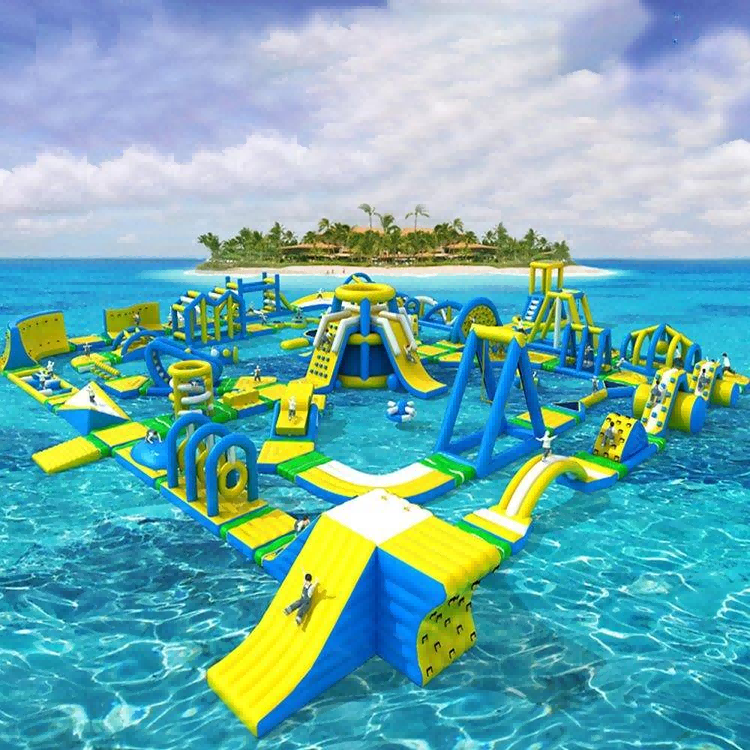
Water-based rental businesses often build their product collections around activities that attract different customer groups. Some customers want simple floating products for relaxation, while others look for larger inflatable structures that support group activities on lakes, beaches or designated water recreation areas.
Common products include inflatable floating mats, water trampolines, floating platforms, inflatable loungers, towable water toys and modular floating structures. Their shapes, dimensions and internal constructions vary considerably. A compact inflatable lounger has different material requirements from a large floating platform designed to support several users.
For manufacturers, the first step is to identify how the finished product will be used. A product intended for occasional private use may have different requirements from one that is inflated, deflated, transported and used repeatedly throughout a busy summer season.
Rental operators also have practical concerns that affect product development:
- How many people will use the product at the same time?
- Will it remain inflated throughout the day?
- Does it need to be deflated and packed after each rental period?
- Will it be used in freshwater, seawater or chlorinated swimming areas?
- How will staff move, clean and store it between bookings?
- Which areas are most likely to experience abrasion, punctures or seam stress?
These questions help manufacturers establish the required fabric properties before selecting a material. A fabric should be evaluated as part of the complete inflatable structure rather than chosen only by its weight or thickness.
Why Does Fabric Selection Matter for Rental Inflatables?
An inflatable product used by a rental business may experience a different usage pattern from one purchased for occasional personal recreation. It can be handled by different users, moved across sand or concrete, exposed to sunlight and moisture, and stored repeatedly between operating periods.
The fabric must perform under these conditions while remaining suitable for the product’s construction method.
Repeated Inflation and Deflation
Some rental products stay inflated for most of the operating day. Others are deflated after use to save storage space or simplify transportation. Repeated inflation and deflation can place stress on fabric folds, welded seams, connection points and areas where accessories are attached.
A material that performs well in a flat sample may behave differently after repeated folding. Manufacturers should therefore examine flexibility, coating adhesion and the condition of welded areas after practical inflation and deflation cycles.
The test should reflect the intended product structure. A small inflatable accessory and a large floating platform do not necessarily experience the same folding pressure or load distribution.
Abrasion During Handling
Rental equipment is frequently moved between storage areas, vehicles, beaches and water access points. The underside of a floating product may come into contact with sand, rough ground, docks or other equipment.
Abrasion resistance becomes particularly important in areas that regularly touch the ground or experience friction during transportation. Manufacturers should identify these contact areas and consider whether the base fabric, coating construction or additional protective design features need adjustment.
A higher-denier fabric may be considered for areas exposed to heavier mechanical stress, but denier alone does not determine abrasion performance. Coating properties, yarn construction, fabric density and finished-product design also matter.
Exposure to Water and Sunlight
Inflatable water toys are commonly exposed to moisture, direct sunlight and changing outdoor temperatures. Products used in coastal locations may also come into contact with saltwater, while equipment used around swimming pools may be exposed to cleaning chemicals or chlorinated water.
These conditions should be considered during material selection and product testing. Manufacturers need to evaluate the fabric’s resistance to the actual environment in which the finished product will operate.
For products expected to remain in service over multiple seasons, hydrolysis resistance is another relevant consideration. The suitability of a particular TPU formulation depends on its composition, construction and intended exposure conditions. Product specifications and sample testing should be reviewed before making long-term durability claims.
Which TPU Fabrics Can Be Considered for Inflatable Water Products?
TPU coated fabrics are used in a range of inflatable applications because they can combine a textile base with a thermoplastic polyurethane coating. The textile provides the fabric structure, while the TPU coating contributes to the functional properties required by the finished product.
For inflatable water toys, manufacturers may evaluate TPU coated nylon as one material option. The final choice depends on the product’s dimensions, load requirements, expected handling conditions, welding process and target weight.
Xianglong’s Luftdichte TPU-Gewebe range includes fabrics for inflatable applications, with product options based on different nylon specifications. These provide a starting point for material evaluation rather than a universal specification for every water toy.
210D-TPU-beschichtetes Nylon für gewichtssensible Konstruktionen
A lighter fabric can be useful when the finished product needs to be easier to carry, fold or transport. For smaller inflatable products and structures where overall weight is an important design factor, 210D TPU coated nylon may be included in the initial material assessment.
Xianglong’s XL TPU Coated 210D Nylon product uses a 210D nylon base fabric with a single-sided TPU coating. Its listed product data includes a coating thickness of approximately 0.15 mm and a total fabric weight of 300 ± 15 g/m².
These figures provide a reference for product development, but they do not establish whether the fabric is suitable for a particular inflatable water toy. The manufacturer still needs to check the required tensile strength, tear resistance, coating adhesion, air retention and welding performance against the finished design.
For a product with large contact areas or repeated exposure to rough handling, a lighter construction should not be selected only to reduce material weight. The complete structure must pass the relevant tests.
Product reference: XL TPU-beschichtetes 210D-Nylon
420D TPU Coated Nylon for More Demanding Applications
When a product is expected to experience greater mechanical stress, manufacturers may also evaluate a 420D nylon construction.
Xianglong’s XL TPU Coated 420D Nylon product uses a 420D nylon base with a single-sided TPU coating. Its listed product data gives a coating thickness of approximately 0.15 mm and a total weight of 375 ± 20 g/m².
Compared with the listed 210D construction, this option has a higher total fabric weight. It may be worth testing for product areas where the design calls for a more substantial textile base. However, a higher denier does not automatically mean that a fabric will perform better in every application.
The product’s actual performance depends on the yarn, weave, coating, bonding quality and finished construction. Manufacturers should compare test results rather than make a selection based on denier alone.
For a large floating structure, it may also be necessary to use different materials in different areas. The main body, underside, reinforcement panels and attachment zones can have different mechanical requirements.
Product reference: XL TPU-beschichtetes 420D-Nylon
When Should a Heavier Fabric Be Evaluated?
Some inflatable products have large dimensions, multiple connection points or areas that experience concentrated loads. In these cases, manufacturers may consider heavier fabric constructions for specific parts of the product.
An 840D nylon construction, for example, may be included in a comparison when the design requires a heavier textile base. The decision should still be based on the actual load conditions, flexibility requirements, fabrication process and test results.
Using a heavier fabric throughout an entire product can increase material consumption and finished weight. It may also make folding and transportation more difficult. A better approach is to identify the areas that need additional reinforcement and evaluate the material requirements for each area separately.
The final construction should balance mechanical performance, weight, handling and manufacturing cost.
How Should Fabric Be Selected for Different Parts of an Inflatable Water Toy?
A water inflatable is not exposed to the same forces at every point. The main body, underside, handles and welded seams each have their own requirements. Treating the entire product as one uniform material-selection problem can lead to unnecessary weight or insufficient reinforcement.
Main Inflatable Chambers
The main chambers hold the internal air pressure and determine much of the product’s shape and buoyancy. Fabric selection should take account of air retention, coating integrity, seam strength and the expected operating pressure.
The material also needs to work with the manufacturer’s welding equipment and production process. A fabric that is difficult to weld consistently can create production problems even if its laboratory properties appear suitable.
Underside and Contact Areas
The underside may experience friction when the product is dragged, moved or placed on a rough surface. Manufacturers should assess the level of abrasion expected during normal operation and transportation.
Depending on the design, additional reinforcement or a different fabric construction may be considered in these areas. The decision should be supported by abrasion and wear testing that reflects the intended use.
Handles and Attachment Points
Handles, towing connections and other attachment points can concentrate force in a relatively small area. The surrounding fabric may experience repeated pulling, lifting and movement.
These locations require careful structural design. Reinforcement patches, seam layout and load distribution can be as important as the fabric specification itself. Simply changing to a heavier material does not solve every attachment problem.
Welded Seams and Connecting Panels
The seams are part of the inflatable’s load-bearing and air-retention structure. Their performance depends on fabric compatibility, surface condition, welding parameters and production consistency.
Manufacturers should test representative welded samples before starting mass production. Seam strength, appearance, air leakage and performance after repeated handling should all be included in the evaluation.
What Fabric Properties Should Manufacturers Check?
For inflatable water toys, fabric selection should be based on measurable properties and production trials. A product description may provide an initial reference, but it cannot replace a technical data sheet or finished-product testing.
The following properties deserve particular attention.
Air Retention
The fabric and its welded joints must work together to maintain the required internal pressure. Manufacturers should check air permeability and test the finished structure for leakage.
Testing should use the intended operating pressure and follow a consistent procedure. The acceptable pressure change depends on the product design, testing conditions and manufacturer’s requirements.
Haftung der Beschichtung
The TPU coating must remain bonded to the textile base during fabrication and use. Poor adhesion can affect the fabric’s service performance and may cause problems during welding or repeated folding.
Coating adhesion should be checked using an appropriate test method. Manufacturers should also inspect samples after folding, environmental exposure and other relevant conditioning procedures.
Tensile and Tear Strength
Tensile strength indicates how the fabric responds to pulling forces, while tear strength helps assess its resistance to the propagation of a cut or tear.
Both properties are relevant, but neither should be considered in isolation. A fabric with suitable tensile strength may still need additional reinforcement around handles, corners or other high-stress areas.
Flexibility and Folding Performance
Inflatable products designed for rental operations may be folded and packed regularly. Fabric flexibility affects handling, storage and the condition of the coating after repeated use.
Manufacturers should inspect samples after repeated folding and unfolding. Particular attention should be given to creases, coating cracks, delamination and changes in air-retention performance.
Hydrolysis Resistance
In warm and humid environments, moisture and temperature can influence the long-term performance of some polyurethane materials. Hydrolysis-resistant fabric options may be worth evaluating when the product is expected to face prolonged exposure to humid conditions.
The actual suitability depends on the TPU formulation and the intended service environment. Manufacturers should request relevant technical information and conduct appropriate aging tests rather than rely only on a general product label.
How Do TPU Coated Fabrics Affect the Manufacturing Process?
Material selection also affects how an inflatable water toy can be manufactured. Even when the fabric has suitable mechanical properties, the production team must confirm that it can be processed consistently.
Hochfrequenzschweißen
High-frequency welding is used in the production of many TPU coated fabric products. It uses electromagnetic energy to generate heat within compatible thermoplastic materials, allowing the coated surfaces to bond under pressure.
For inflatable products, the welding process needs to produce consistent seams with sufficient strength and air retention. The correct settings depend on the fabric construction, coating characteristics, machine conditions and joint design.
Before mass production, manufacturers should establish suitable welding parameters through sample trials. They should examine the seam width, appearance, bonding quality and strength rather than relying on a single successful sample.
Heißsiegeln
Heat sealing may also be used in suitable TPU coated fabric constructions. The process requires control of temperature, pressure and dwell time.
Different fabric specifications may respond differently to the same settings. A production team should therefore confirm the process window for each material and product construction.
Material Consistency Between Batches
Rental products are often produced in batches, and manufacturers may need to repeat the same design across multiple production runs. Differences in fabric weight, coating thickness, surface condition or bonding characteristics can affect production results.
A practical incoming inspection procedure should include:
- Checking fabric width and total weight
- Reviewing the product specification and batch information
- Inspecting the coating surface for visible defects
- Confirming the material is suitable for the planned welding process
- Retaining samples for production comparison where necessary
These checks help reduce avoidable variation before the fabric enters the production line.
Which Tests Should Be Completed Before Mass Production?
A fabric sample is only one part of the evaluation. The finished inflatable product needs to be tested in a way that reflects its intended operating conditions.
A useful testing plan can include the following stages.
1. Incoming material inspection
Check the fabric against the approved specification. Confirm the base fabric, coating construction, weight and visible surface condition. Any differences should be reviewed before production continues.
2. Fabric performance testing
Evaluate tensile strength, tear strength, coating adhesion, abrasion resistance and other properties relevant to the product design. The test methods and acceptance criteria should be established before testing begins.
3. Welding trials
Produce representative welded samples using the intended equipment and process settings. Check seam strength, bonding consistency and air leakage.
4. Inflation and pressure testing
Inflate the prototype according to the manufacturer’s specified procedure. Inspect the chambers and seams for leakage, deformation and other signs of structural problems.
5. Repeated-use evaluation
Where the product will be folded and stored frequently, conduct repeated inflation, deflation and folding tests. Inspect the coating, seams and reinforcement areas after the cycles.
6. Environmental evaluation
Consider the actual conditions in which the product will be used. Depending on the market and application, testing may include exposure to water, sunlight, temperature changes, humidity and relevant cleaning agents.
7. Practical water testing
The finished product should be evaluated under controlled and appropriate conditions before commercial use. Load limits, stability, user instructions and applicable product safety requirements need to be addressed by the finished-product manufacturer.
Passing a fabric test does not automatically establish that the complete inflatable product is safe or suitable for rental use. Product-level design validation remains essential.
How Can Rental Businesses Build a More Practical Inflatable Product Range?
A rental operator may want several types of water toys for different customer groups. Manufacturers and product developers can help by organizing product requirements around intended use rather than offering one material specification for every design.
For example, a compact floating lounger may prioritize manageable weight and convenient storage. A large floating platform may require a more detailed assessment of chamber construction, connection points and load distribution. A towable inflatable product may experience different forces during use and require its own structural evaluation.
Before developing or sourcing a new product, the rental business and manufacturer should agree on several points:
- Intended number of users and product load limits
- Freshwater, seawater or swimming-pool use
- Expected daily operating hours
- Inflation and deflation frequency
- Transportation and storage arrangements
- Cleaning and maintenance procedures
- Expected service life and replacement requirements
This information gives the manufacturer a clearer basis for selecting fabric, designing reinforcement and planning production tests.
Rental operators should also request product information from their finished-product suppliers, including operating instructions, maintenance requirements, load limits and relevant safety documentation. These details are important when products will be used by different customers throughout the season.
What Should Manufacturers Ask a TPU Fabric Supplier?
A clear technical discussion with the fabric supplier can prevent material mismatches later in production. Instead of asking only for a price per meter, manufacturers should provide basic information about the intended inflatable product.
Useful details include the product type, approximate dimensions, expected operating conditions, target weight, construction method and any known performance requirements.
The supplier can then help identify suitable fabric options for sample evaluation. Manufacturers should request the relevant technical data sheet and confirm which specifications are available for the proposed material.
For a new water inflatable project, the following questions are worth discussing:
- Which nylon base fabric specifications are available?
- What are the coating thickness and total fabric weight?
- Is the fabric compatible with the planned high-frequency welding or heat-sealing process?
- What test data is available for tensile strength, tear strength and coating adhesion?
- Is there information on hydrolysis resistance and environmental performance?
- Can samples be provided for prototype production and process trials?
- Are the same specifications available for repeat orders?
A supplier’s product range can help narrow down the initial options, but the final material should be approved through the manufacturer’s own production and product testing.
For rental businesses planning to expand their inflatable water toy collections, fabric selection has a direct influence on product weight, handling, manufacturing and long-term maintenance. The right material depends on the product’s structure and operating conditions, not simply on choosing the highest denier or heaviest fabric.
TPU coated nylon is one material option that manufacturers can evaluate for inflatable water products. Different constructions, including 210D and 420D nylon, provide starting points for comparing weight and mechanical requirements. The final decision should be based on technical specifications, welding trials and finished-product testing.
Xianglong’s Luftdichte TPU-Gewebe range includes material options for inflatable applications, while its Water Sports and Marine application range provides further reference for water-related product development. Manufacturers can review the available specifications and request samples to assess compatibility with their own designs.
For products intended for repeated rental use, a reliable result comes from matching the fabric, reinforcement design, welding process and maintenance requirements to the actual conditions of use. That work should be completed before the product enters regular commercial operation.