

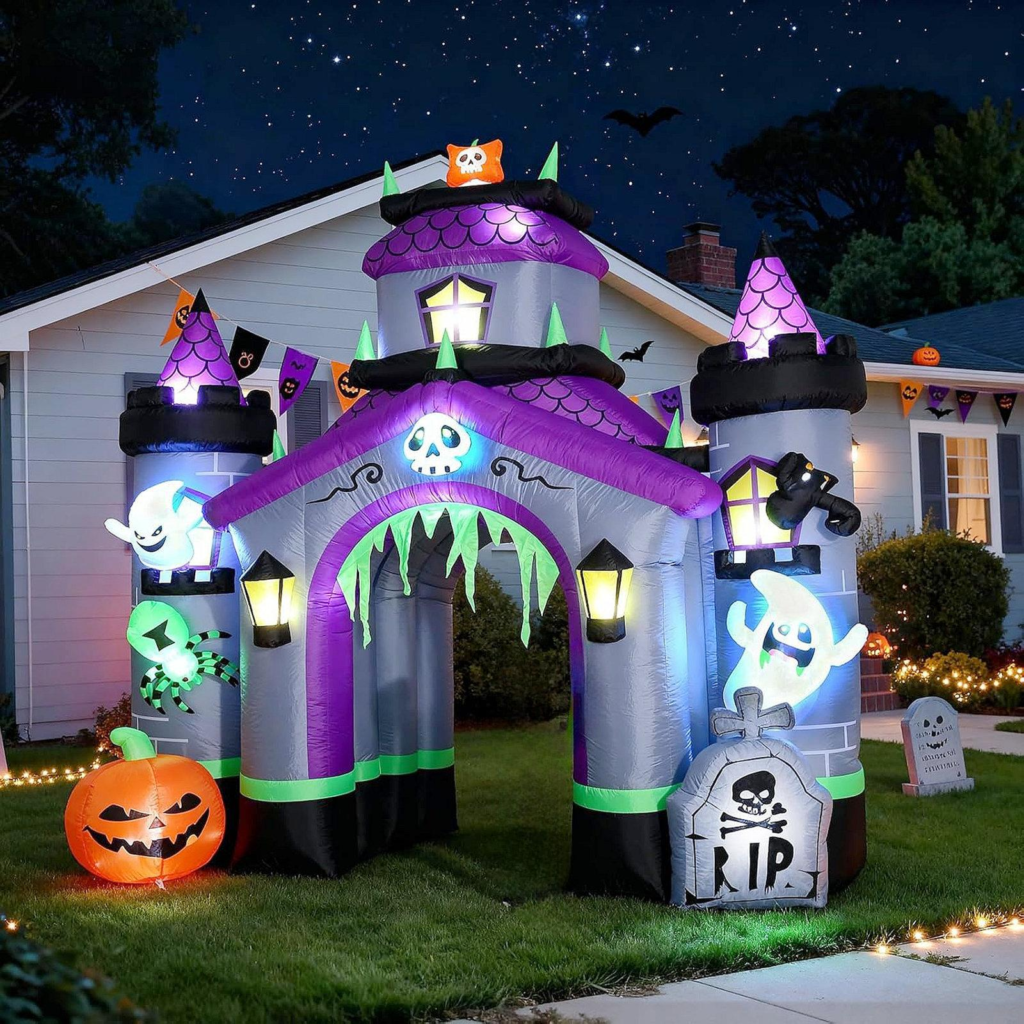
Les décorations gonflables d’Halloween sont devenues un choix populaire pour les présentations résidentielles, les lieux commerciaux, les centres commerciaux, les parcs à thème et les événements saisonniers. De grandes citrouilles, des fantômes, des squelettes, des maisons hantées et des figures lumineuses peuvent créer un effet visuel impressionnant sans nécessiter de structures permanentes complexes. Toutefois, pour les fabricants, produire une décoration gonflable esthétique n’est qu’une partie du travail. Le matériau doit également résister aux intempéries, aux gonflements et dégonflements répétés, aux manipulations lors de l’installation ainsi qu’au stockage entre deux saisons.
Le choix du tissu influence directement la durée de vie du produit fini, son aspect, son poids et son coût de fabrication. Les matériaux gonflables traditionnels offrent peut‑être une protection imperméable ou une résistance suffisante, mais ils ne garantissent pas toujours le bon équilibre entre flexibilité, poids, étanchéité et performances de transformation pour chaque conception.
Tissu enduit de TPU propose aux fabricants une autre option de matériau. En combinant une base textile avec un revêtement en polyuréthane thermoplastique, il peut apporter des propriétés utiles à différentes structures gonflables, allant de légères figurines décoratives jusqu’à de plus grands accessoires extérieurs nécessitant une résistance mécanique accrue. La configuration adéquate dépend de la structure du produit, des conditions d’utilisation et de la durée de vie attendue.
Quelles exigences matérielles sont essentielles pour les décorations gonflables d’Halloween ?
Les décorations gonflables d’Halloween sont souvent utilisées dans des environnements où les conditions météorologiques et de manipulation sont difficiles à maîtriser. Une décoration exposée dans une cour avant peut être soumise à la pluie, au soleil, aux variations de température, ainsi qu’au contact avec l’herbe, les pavés ou d’autres objets environnants. Les installations commerciales impliquent également des déplacements fréquents, ainsi que le montage et le démontage.
Ces conditions entraînent plusieurs exigences matérielles.
Étanchéité à l’eau pour les expositions extérieures
La pluie et l’humidité du sol peuvent affecter l’apparence et les performances des décorations extérieures. Un tissu doté d’un revêtement imperméable approprié empêche l’eau de pénétrer à travers la structure textile. Cela est particulièrement important pour les figurines décoratives placées sur des pelouses, près des entrées ou dans des espaces commerciaux ouverts.
L’étanchéité à l’eau doit être envisagée conjointement avec la construction du produit fini. Les trous de couture, les points de connexion, les fermetures éclair, les valves et autres ouvertures peuvent laisser passer l’eau même lorsque le tissu principal est recouvert d’un revêtement imperméable. Les fabricants doivent évaluer l’ensemble de la structure plutôt que de se fier uniquement au revêtement.
Flexibilité lors des gonflements et dégonflements
Les décorations gonflables changent régulièrement de forme lorsqu’elles sont gonflées, repliées, emballées et stockées. Le tissu doit supporter ces mouvements sans devenir excessivement rigide ni subir de dommages autour des zones soumises à de fortes contraintes.
Des revêtements TPU flexibles peuvent aider à préserver la souplesse du matériau, bien que la performance finale dépende de la formulation du TPU, de l’épaisseur du revêtement, du support textile et de la température d’utilisation. Un tissu adapté à une petite décoration gonflable peut ne pas convenir à une grande structure exposée à des tensions plus importantes.
Résistance mécanique pour une utilisation répétée
Les décorations extérieures peuvent être déplacées, pliées, tirées et exposées à des contacts accidentels. Des matériaux fins réduisent le poids du produit, mais peuvent être moins adaptés aux designs soumis à de fortes contraintes aux angles, aux points d’attache ou aux structures de soutien.
La résistance à la déchirure et à l’abrasion doit donc être prise en compte lors du choix du matériau. Le tissu doit correspondre aux conditions de manipulation prévues, plutôt que de se contenter d’atteindre un poids minimal.
Poids adapté au transport et à l’installation
De nombreuses décorations saisonnières sont conçues pour être rangées après usage. Un poids de tissu plus faible peut réduire les besoins de transport et de stockage, surtout pour les grandes figurines décoratives. Toutefois, une construction légère ne doit pas compromettre la résistance nécessaire au produit.
Le bon équilibre dépend des dimensions, de la méthode de gonflement, de la structure interne et de l’exposition prévue de la décoration.
Comment le tissu enduit de TPU facilite‑t‑il la production de décorations gonflables ?
Le tissu enduit de TPU est composé d’une base textile associée à une couche de polyuréthane thermoplastique. Le textile assure la majeure partie du soutien mécanique, tandis que le revêtement TPU apporte des propriétés telles que l’étanchéité à l’eau, la flexibilité et la possibilité de procéder à des assemblages par chaleur.
Cette combinaison offre aux fabricants la possibilité de choisir différentes configurations de tissu selon les applications gonflables.
Une combinaison de résistance du textile et de performance du revêtement
Le tissu de base influence la résistance à la traction, la résistance à la déchirure, la stabilité dimensionnelle et le poids global. Le nylon et le polyester sont des substrats couramment utilisés dans les tissus techniques enduits, mais leurs caractéristiques de performance diffèrent.
Le nylon est souvent choisi lorsque la flexibilité et la résistance mécanique sont primordiales. Le polyester peut s’avérer utile lorsque la stabilité dimensionnelle et la résistance aux variations liées à l’humidité sont prioritaires. La construction du revêtement doit également être prise en compte, car le substrat seul ne détermine pas les performances du matériau fini.
Pour les décorations gonflables d’Halloween, les fabricants devraient évaluer l’ensemble du tissu enduit de TPU plutôt que de sélectionner un matériau uniquement sur la base de ses spécifications textiles.
Protection imperméable pour les applications extérieures
Les revêtements TPU peuvent former une couche protectrice sur le substrat textile. Lorsque le revêtement est continu et correctement fabriqué, il aide à empêcher l’eau de pénétrer à travers le tissu lui‑même.
Cela rend les matériaux enduits de TPU intéressants pour les citrouilles, les fantômes, les squelettes, les arches décoratives et autres accessoires saisonniers destinés à l’extérieur. Il reste toutefois nécessaire d’évaluer les coutures, les fermetures et les points de connexion, car la résistance à l’eau du produit fini dépend de bien plus que de la surface du tissu.
Flexibilité pour le pliage et le stockage
Les décorations saisonnières ne restent pas toujours gonflées toute l’année. De nombreux produits sont dégonflés, pliés, emballés et stockés pendant plusieurs mois avant d’être à nouveau utilisés.
Un tissu enduit flexible peut faciliter le pliage et la manipulation. Le choix du matériau doit tenir compte des pliages et compressions répétés, notamment autour des plis, des coins et des zones où le tissu entre en contact avec des supports internes.
Les fabricants devraient tester des échantillons en les soumettant à des cycles répétés de gonflement, de dégonflement et de pliage. Un tissu qui fonctionne bien dans un nouvel état peut se comporter différemment après un long stockage ou une utilisation répétée.
Le tissu TPU léger convient‑il aux décorations gonflables d’Halloween ?
Le poids est un facteur crucial pour les fabricants de décorations gonflables. Les grandes figurines peuvent nécessiter d’importantes quantités de tissu, et ce matériau contribue au poids total du produit. Une construction plus légère peut rendre le transport, l’installation et le stockage saisonnier plus pratiques.
Les tissus légers enduits de TPU peuvent être envisagés pour les petites figurines décoratives et les produits gonflables où la portabilité est prioritaire.
Par exemple, des constructions en nylon 20D enduit de TPU et en polyester léger peuvent être évaluées pour des décorations gonflables compactes, de petites citrouilles, des fantômes légers et d’autres produits aux exigences structurelles relativement modestes. Leur adéquation dépend de la spécification précise du tissu et de la conception du produit fini.
Où les matériaux légers offrent une valeur pratique
Les tissus légers peuvent apporter plusieurs avantages en termes de fabrication et de produit :
- Un poids de matériau réduit peut diminuer le poids global des produits gonflables compacts.
- Des constructions flexibles peuvent faciliter le pliage et l’emballage.
- Des paquets de tissu plus petits simplifient le transport et le stockage en entrepôt.
- Les matériaux légers peuvent convenir à des produits qui ne subissent pas de fortes contraintes mécaniques.
- La flexibilité du matériau peut soutenir des formes décoratives aux surfaces courbes et aux panneaux multiples.
These benefits are most relevant when the product design does not require heavy reinforcement or high resistance to repeated physical contact.
Why lightweight should not be the only selection criterion
A large outdoor inflatable decoration may experience wind pressure, movement around its anchor points, and tension across its panels. A very lightweight fabric may not provide sufficient resistance for these conditions.
Manufacturers should consider fabric weight together with tensile strength, tear resistance, coating adhesion, and the dimensions of the inflatable structure. Reinforcement may also be required around tie-down points, seams, and other concentrated stress areas.
A lightweight fabric is not automatically the most economical option. If the finished decoration requires frequent repairs or replacement, the initial material savings may be offset by higher service costs.
When Should Manufacturers Choose 210D, 420D, or 840D TPU Coated Fabric?
Not every Halloween inflatable decoration needs a lightweight fabric. Larger outdoor props, reusable commercial displays, and products exposed to frequent handling may require a more robust textile construction.
TPU coated nylon fabrics in 210D, 420D, and 840D constructions provide different options for manufacturers evaluating strength, weight, and handling requirements. Denier describes the linear density of the yarn, but it should not be treated as a direct measurement of finished fabric strength. Weave construction, coating, yarn quality, and manufacturing processes also influence performance.
| Fabric construction | Potential application direction | Main selection consideration |
|---|---|---|
| 210D TPU coated nylon | Medium-sized decorative inflatables and general-purpose props | Balance between weight and mechanical performance |
| Nylon enduit de TPU 420D | Larger outdoor decorations and reusable event props | Greater fabric robustness for repeated handling |
| Nylon enduit de TPU 840D | Heavy-duty decorative structures and demanding applications | Higher material weight and the need for stronger construction |
The table provides a starting point for material evaluation rather than a universal specification. Actual suitability must be confirmed through technical data and product testing.
210D for moderate material requirements
A 210D construction may be worth evaluating for inflatable decorations that need a balance between manageable weight and fabric strength. It can be considered for medium-sized pumpkins, ghosts, and other decorative figures, provided the design does not place excessive stress on the material.
The coating type and thickness should be matched to the intended application. Manufacturers should also check whether the selected construction can be processed using their planned joining method.
420D for larger and reusable props
A 420D TPU coated nylon fabric may be more appropriate when the decoration has a larger surface area or is expected to undergo frequent transportation and installation.
For example, commercial event operators may reuse the same inflatable decorations across several seasonal campaigns. In this case, resistance to handling damage becomes an important part of material selection.
Manufacturers should pay particular attention to the areas around attachment points, seams, and corners. These locations may experience more concentrated stress than the main fabric panels.
840D for demanding applications
An 840D construction can be considered for applications where a heavier textile base is needed. Large outdoor props, rugged event structures, and decorations that experience frequent handling may require this type of material evaluation.
However, a heavier fabric can also increase the total product weight and affect folding, transportation, and installation. It may not be necessary for small decorative figures or products designed for occasional indoor use.
The best construction is the one that meets the product’s mechanical requirements without adding unnecessary material weight or cost.
How Does TPU Coated Fabric Perform in Outdoor Halloween Conditions?
Outdoor use introduces several variables that manufacturers cannot fully control. Rain, sunlight, temperature changes, wind, and contact with surrounding surfaces can all affect the finished decoration.
Material selection should therefore be based on the actual operating environment.
Rain and moisture exposure
Waterproof TPU coated fabric can help protect the textile substrate from direct water penetration. This is useful for inflatable decorations displayed in gardens, outdoor shopping areas, and public event spaces.
However, the finished product still needs appropriate construction around seams, zippers, electrical connections, and other openings. For blower-driven inflatables, the design may also include ventilation openings that are part of normal operation. These should not be confused with defects in the coated fabric.
Manufacturers should test the complete decoration under conditions that reflect its intended use.
Sunlight and outdoor aging
Decorations displayed outdoors may receive prolonged exposure to sunlight. UV radiation can gradually affect polymers, coatings, colors, and other exposed components.
The degree of change depends on the TPU formulation, pigments, stabilizers, coating thickness, and exposure conditions. A general TPU fabric specification does not automatically establish long-term UV resistance.
For products intended for repeated outdoor use, manufacturers should request relevant test information from the material supplier and conduct aging evaluations where necessary. Color retention should also be checked, especially for bright orange, purple, green, and other colors commonly used in Halloween designs.
Temperature changes
Halloween displays may be installed in different climates. Some products are used in relatively warm autumn conditions, while others may experience cold nights or sudden temperature changes.
TPU formulations vary in low-temperature flexibility. Manufacturers should confirm the operating temperature range of the selected fabric rather than assuming that all TPU coated materials behave identically.
Cold-temperature testing can help identify whether the material becomes too stiff, develops surface cracks, or loses flexibility during folding and handling.
Wind and repeated movement
Large inflatable decorations can move under wind pressure. This movement may transfer stress to seams, anchor points, and connection areas.
Fabric strength is only one part of the solution. The decoration also needs suitable anchoring, balanced panel design, and reinforcement at stress concentration points.
For outdoor installations, manufacturers should evaluate the complete structure under realistic conditions rather than expecting the coated fabric alone to prevent wind-related damage.
Does Airtight TPU Fabric Suit Every Type of Halloween Inflatable?
The term inflatable decoration covers several different product structures. Some products use a sealed air chamber, while others rely on a continuous air supply from an electric blower. These two designs have different material and construction requirements.
Understanding the difference is important when selecting TPU coated fabric.
Sealed inflatable structures
A sealed inflatable product is designed to retain air within an enclosed chamber. Examples in other industries include inflatable sleeping pads, pillows, air cells, and certain portable structures.
For this type of construction, airtightness is a major material requirement. The coated fabric and its joining points must work together to limit air leakage.
Airtight TPU fabrics may be considered for sealed decorative products where the design requires air retention. Manufacturers need to verify the coating construction, joining compatibility, and air retention performance of the selected material.
Continuous-air inflatable decorations
Many large Halloween lawn decorations use an electric blower to maintain their shape. These products are not necessarily designed to retain air after the blower is switched off. Instead, air continuously enters the structure and escapes through designated openings or fabric areas.
For this type of product, the material requirements may place greater emphasis on lightweight construction, tear resistance, water resistance, flexibility, and seam durability.
Selecting a fabric only because it has high airtightness may not provide a meaningful advantage if the product is designed for continuous airflow. Manufacturers should match the material to the actual inflation method.
Why product structure should guide material selection
Before requesting a fabric quotation, manufacturers should clarify several design details:
- Is the product sealed or continuously inflated by a blower?
- What are the finished dimensions and expected operating pressure?
- Will the decoration be used indoors, outdoors, or in both environments?
- How frequently will it be inflated, deflated, folded, and transported?
- Are there areas that require additional reinforcement?
- Which joining process will be used during production?
These details help suppliers recommend a more suitable construction and reduce the risk of selecting a material that does not match the finished product.
How Does Fabric Joining Affect the Durability of Inflatable Decorations?
The durability of an inflatable decoration depends on both the fabric and the way its panels are joined. Even a technically suitable coated material can fail if the seams are poorly designed or processed.
For TPU coated fabric, high-frequency welding is one possible joining method, depending on the material construction and processing requirements. The compatibility of a specific fabric with HF welding should always be confirmed through production trials.
HF welding and seam consistency
High-frequency welding uses electromagnetic energy to generate heat within compatible thermoplastic materials. Under suitable processing conditions, it can create a bonded seam without relying on conventional needle stitching.
For inflatable products, seam quality affects air retention, structural strength, and long-term reliability. Manufacturers should evaluate welding temperature, pressure, processing time, electrode design, and material thickness.
A production setting that works for one TPU coated fabric may not work for another. Changes in coating formulation, substrate, and thickness can affect the welding window.
Reinforcement around high-stress areas
Certain parts of a Halloween inflatable decoration experience more stress than others. These may include:
- Tie-down and anchoring points
- Connections between the main body and decorative components
- Corners and curved transitions
- Valve or blower connection areas
- Handles and transportation points
Additional fabric layers or structural reinforcement may be required in these locations. The reinforcement design should distribute the load instead of creating an abrupt transition that concentrates stress at its edge.
Balancing appearance and manufacturing performance
Halloween decorations often contain complex shapes, contrasting colors, printed patterns, and multiple connected components. The material must support the intended visual design while remaining practical for cutting, joining, and assembly.
Manufacturers should test the complete panel construction before mass production. A visually attractive design may still create production difficulties if narrow seams, sharp corners, or complicated panel intersections are difficult to process consistently.
What Tests Should Manufacturers Conduct Before Mass Production?
Material samples and finished product prototypes should be evaluated before large-scale production. Testing helps identify weaknesses that may not be obvious from a technical data sheet or a visual inspection.
The exact test plan depends on whether the decoration is sealed or blower-driven, its size, and the conditions under which it will be used.
| Test item | What it evaluates | Pourquoi c'est important |
|---|---|---|
| Résistance à la traction | Resistance to pulling forces | Helps assess fabric suitability for structural loads |
| Résistance aux déchirures | Resistance to tear propagation | Important around corners and damaged areas |
| Adhérence du revêtement | Bonding between coating and textile | Helps identify coating separation risks |
| Résistance à l'eau | Resistance to water penetration | Relevant to outdoor displays |
| Flexibility testing | Material behavior during bending and folding | Supports repeated storage and handling |
| Seam strength | Strength of joined fabric panels | Helps assess finished product reliability |
| Air retention testing | Leakage through fabric and seams | Required for sealed inflatable structures |
| Aging evaluation | Changes after environmental exposure | Useful for products intended for repeated outdoor use |
For sealed products, air leakage testing should include both the fabric and the finished seams. For continuous-air decorations, manufacturers should instead evaluate blower performance, airflow, structural stability, and the behavior of the material during extended operation.
A prototype should also be inflated and deflated repeatedly. This helps identify problems around welded seams, folds, valves, and reinforced areas before production quantities increase.
How Can Manufacturers Select the Right TPU Fabric Supplier?
The material supplier plays an important role in maintaining product consistency. For manufacturers producing seasonal decorations, material availability, specification control, and technical communication can influence production schedules and final product quality.
A supplier should be able to provide more than a general product description.
Check the technical specifications
Manufacturers should request information about the textile substrate, denier, coating type, thickness, weight, and relevant performance test results.
For TPU coated fabrics, it is also useful to clarify whether the coating is single-sided or double-sided and whether the material uses a polyester-based or polyether-based TPU formulation. These details can influence application suitability and processing behavior.
Confirm processing compatibility
If the production line uses HF welding, the supplier should help confirm whether the selected construction is compatible with the planned process. Sample testing is still necessary because actual welding performance depends on the material and machine settings.
Manufacturers should also check the material’s suitability for cutting, printing, folding, and other operations involved in the production process.
Evaluate customization options
Halloween products often use distinctive colors and visual designs. Material customization may involve color, substrate, coating thickness, fabric weight, and other construction details.
A supplier with customization capabilities can help manufacturers match the material to a specific product design. However, any change in formulation or construction should be reviewed because it may affect mechanical properties and processing performance.
Consider supply consistency
Seasonal production schedules can be demanding. Manufacturers may need to prepare materials well before the Halloween selling period and maintain consistent specifications across different production batches.
A reliable supply arrangement should include clear technical specifications, sample approval, production planning, and quality checks. These steps help reduce unexpected changes during mass production.
Final Considerations for Halloween Inflatable Decoration Manufacturers
TPU coated fabric can provide a useful material option for manufacturers producing Halloween inflatable decorations, particularly where waterproof protection, flexibility, manageable weight, and textile strength are important.
Lightweight TPU coated nylon and polyester constructions may suit compact decorative products, while 210D, 420D, and 840D TPU coated nylon fabrics can be evaluated for larger or more demanding applications. Airtight TPU fabrics may also be relevant to sealed inflatable structures, but they should not be treated as a universal requirement for blower-driven decorations.
The most suitable material depends on the product’s inflation method, dimensions, outdoor exposure, handling frequency, and manufacturing process. Fabric testing, seam evaluation, and prototype trials are essential before mass production.
Xianglong Polymer Fabric supplies TPU coated fabrics in different textile constructions for inflatable, outdoor, and technical applications. Manufacturers can evaluate suitable options according to their required fabric weight, substrate, coating construction, and finished product design. Selecting the material around real production and operating conditions is a more reliable approach than choosing a fabric based on a single specification.