


An inflatable kayak looks simple from the outside. A flexible outer surface, several air chambers, valves, seats, and connection points make up most of the visible structure. The material inside that structure, however, has to deal with a demanding combination of conditions.
It must contain air for long periods, tolerate repeated inflation and deflation, bend during folding, resist abrasion during launching and landing, and maintain its mechanical integrity when the kayak is loaded on the water. For products designed for travel or expedition use, weight becomes another major consideration because the kayak may be carried together with a pump, paddle, dry bag, and other equipment.
For manufacturers, fabric selection therefore starts well before a roll of coated textile reaches the cutting table.
The question is not simply whether a fabric is waterproof. The more useful question is whether the complete material construction matches the kayak’s intended size, pressure, weight target, welding method, and service conditions.
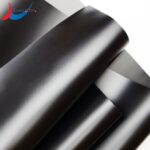
That is why TPU Coated Nylon Fabric for Inflatable Kayaks has become an increasingly practical option for manufacturers developing lightweight and high-performance inflatable watercraft. Nylon provides the textile reinforcement, while TPU creates the airtight polymer layer and provides a surface suitable for welding.
The final performance still depends on the complete construction. A 210D fabric is not automatically better than 420D, and 840D is not automatically the right choice for every kayak. Material selection works best when the fabric is treated as one part of the finished product rather than as an isolated specification.

What Does Inflatable Kayak Fabric Need to Handle?
An inflatable kayak experiences a different set of mechanical conditions from a conventional rigid kayak.
A rigid hull obtains most of its structural stability from its shell. An inflatable kayak depends heavily on air pressure, fabric tension, chamber geometry, internal baffles, welded seams, and reinforcement points.
Once the chambers are inflated, the coated fabric becomes part of the pressure structure.
Several loads appear at the same time.
Internal Air Pressure
The inflated chamber pushes outward against the fabric. The larger the chamber, the greater the area over which the internal pressure acts.
This is one reason why fabric strength cannot be considered independently from kayak geometry.
A small inflatable chamber and a large chamber can use the same fabric but experience different mechanical loading because their dimensions and shapes are different.
User and Equipment Loads
The kayak also has to carry the paddler and equipment.
Load distribution changes as the user moves, enters the kayak, exits, or shifts position. The floor and side chambers may therefore experience different stresses during actual use.
Repeated Folding
Inflatable kayaks are often selected precisely because they can be deflated and transported.
That advantage creates a material requirement of its own.
The fabric may be folded hundreds of times during the product’s life. Sharp creases, repeated bending, compression inside a carrying bag, and subsequent inflation all place mechanical demands on the coated construction.
Abrasion and Local Damage
Launching from a beach, dragging the kayak a short distance, passing close to rocks, or contacting branches can expose the outer surface to abrasion.
For recreational products, occasional contact may be manageable with a lighter fabric construction. Expedition-oriented products may require a considerably more robust reinforcement layer.
The material decision should reflect how the kayak will actually be used.
Why Is Nylon Used Beneath TPU?
A TPU film can provide excellent flexibility and airtightness, but a polymer film by itself does not necessarily provide the mechanical structure required for a full-size inflatable kayak.
That is where nylon comes in.
The woven nylon substrate acts as a reinforcement layer. It contributes tensile strength, tear resistance, dimensional stability, and resistance to mechanical deformation.
The TPU and nylon perform different functions:
Nylon provides structural reinforcement. TPU provides the continuous polymer barrier.
This division of work is one of the most important features of a TPU coated nylon construction.
The coating prevents air and water from passing through the textile structure, while the woven substrate helps the material withstand mechanical loads.
The performance of the finished fabric depends on the relationship between these layers. Coating adhesion, textile density, TPU formulation, film thickness, and fabric construction all matter.
210D, 420D, or 840D Nylon: Which One Makes Sense?
One of the most common questions from inflatable product manufacturers is which denier should be selected.
There is no universal answer.
The correct choice depends on the intended product.
A manufacturer designing a backpacking kayak has different priorities from a company producing a large expedition kayak. Reducing fabric weight may be critical in one case, while abrasion resistance and heavy-duty handling may dominate the other.
210D Nylon for Lightweight Inflatable Kayaks
210D nylon is attractive when portability is a major product requirement.
A lightweight kayak may be carried over a considerable distance before reaching the water. It may also be packed into a relatively small carrying bag.
Reducing fabric weight can therefore have a direct effect on the overall product.
The advantages of a 210D construction can include:
- Lower overall fabric weight
- Good flexibility
- Easy folding
- Compact packability
- Good strength-to-weight performance
The trade-off is that a lighter textile does not provide the same mechanical reserve as a heavier construction.
For lightweight recreational kayaks, touring products, and packable watercraft, 210D can be a sensible starting point when the product design does not demand heavy-duty abrasion resistance.
420D Nylon as a Balanced Construction
420D sits between lightweight and heavy-duty constructions.
For many recreational inflatable kayaks, this middle position can be attractive.
The manufacturer gets more textile reinforcement than a 210D structure while avoiding some of the additional weight associated with 840D.
A 420D TPU coated nylon construction may therefore be considered when the product needs a balance between:
- Weight
- Tear resistance
- Abrasion resistance
- 柔軟性
- 耐久性
- Production cost
For a general-purpose inflatable kayak intended for regular outdoor use, this balance can be more useful than simply choosing the heaviest available fabric.
840D Nylon for Heavy-Duty Applications
840D is a different design direction.
The heavier textile structure is more appropriate when the manufacturer places greater emphasis on mechanical durability and abrasion resistance.
Potential applications include expedition kayaks, commercial watercraft, heavy-use recreational products, and products that are likely to encounter rougher handling.
The additional textile weight is the trade-off.
An 840D construction may provide greater mechanical strength, but that does not automatically make it the best choice for an ultralight kayak.
A product manager has to decide where the product sits between portability and ruggedness.
| Nylon Base | Main Strength | Typical Product Direction |
|---|---|---|
| 210D | Low weight and flexibility | Lightweight and packable kayaks |
| 420D | Balanced strength and weight | General recreational kayaks |
| 840D | Heavy-duty reinforcement | Expedition and high-abrasion products |
These categories should be treated as design references rather than fixed rules. Actual performance depends on yarn construction, weave, TPU formulation, coating thickness, welding, and finished-product geometry.
なぜPVCではなくTPU?
PVC has been widely used in inflatable products for many years, and it remains commercially relevant because of its established processing methods and cost advantages.
TPU becomes attractive when manufacturers want a different balance of flexibility, durability, weight, and material positioning.
For an inflatable kayak, flexibility matters because the product is constantly moving.
The material needs to tolerate inflation, use, deflation, folding, transportation, and inflation again.
Flexibility During Folding
A rigid or excessively stiff coating can make packing less convenient and can create greater stress around repeated fold areas.
TPU can be formulated to remain flexible over a broad temperature range, which is useful for outdoor equipment that may be used in different climates.
Low-temperature behavior deserves particular attention for kayaks used in cold-water environments. A material that becomes noticeably stiffer can change the handling and folding characteristics of the finished product.
Abrasion and Mechanical Durability
TPU can provide good abrasion resistance, although the exact performance depends on the selected grade and formulation.
For a kayak, this is important because the coated surface may encounter sand, gravel, equipment, and repeated contact with the ground.
The appropriate TPU grade should therefore be selected according to the actual exposure rather than based solely on the name “TPU.”
PVC-Free Product Positioning
Environmental requirements are also influencing material decisions.
TPU can be formulated without the conventional plasticizer system commonly associated with flexible PVC. This allows manufacturers to develop PVC-free inflatable products for markets where material composition is part of the purchasing decision.
However, environmental claims should be based on the actual formulation, manufacturing process, and relevant compliance documentation.
Calling a product “more environmentally friendly” without examining the complete material system is not enough for serious product development.
TPU Coated Nylon Needs to Be Designed for Welding
For inflatable kayaks, the fabric is only half of the material story.
The other half is what happens when the fabric is converted into a finished air chamber.
Sewing alone creates puncture points. Needle holes can become potential leakage paths, and stitched seams require additional sealing if the product must retain air.
With a weldable TPU coated construction, the TPU surfaces can be joined to form sealed seams.
Depending on the fabric construction and production equipment, manufacturers may use:
- High-frequency welding
- Heat welding
- RF welding
- Other compatible thermal joining methods
The exact process needs to be developed around the selected material.
Why TPU-to-TPU Welding Matters
When two compatible TPU surfaces are joined under controlled heat, pressure, or electromagnetic energy, the polymer layers can form a continuous sealed joint.
This is particularly useful for inflatable kayaks because the finished product may contain:
- Main air chambers
- Internal baffles
- Floor chambers
- Bow and stern sections
- Valve areas
- Reinforcement panels
Every seam becomes part of the air-retention system.
A fabric with excellent tensile strength can still produce a poor kayak if the welding process is not properly controlled.
For this reason, fabric qualification should include welding trials before mass production.
Welding Parameters Cannot Be Copied Blindly
Different TPU film thicknesses and formulations can require different welding conditions.
Temperature, pressure, time, electrode design, and seam geometry all influence the finished joint.
The welding window should therefore be established with the actual fabric construction.
A manufacturer changing from one TPU film thickness to another should not assume that the previous production parameters will produce identical results.
This is a practical issue that often matters more in production than a difference of several points in a laboratory material test.
How Much Air Pressure Can TPU Kayak Fabric Handle?
This is one area where material specifications are frequently misunderstood.
It is tempting to look at a fabric datasheet and ask:
“What is the maximum pressure this fabric can withstand?”
The answer cannot be determined from denier, TPU thickness, tensile strength, or coating specification alone.
A fabric does not have one universal pressure rating for every inflatable kayak.
The actual stress within the material depends on the finished product.
Important variables include:
- Chamber dimensions
- Kayak length and width
- チャンバー直径
- Internal pressure
- Fabric orientation
- Seam configuration
- Weld width
- Baffle spacing
- Reinforcement
- Load distribution
- 製品形状
A larger chamber can experience a different membrane load from a smaller chamber even when both use exactly the same fabric.
The same 420D TPU coated nylon may therefore be appropriate for one inflatable structure and unsuitable for another if the geometry and operating conditions are substantially different.
Pressure Should Be Evaluated at Product Level
For a new kayak design, pressure testing should be performed on the actual air chamber or finished product.
The development process should consider the intended operating pressure, maximum design pressure, chamber geometry, seams, valves, and load conditions.
The material is one component of the pressure system.
This is why giving a single pressure number based only on the fabric would be misleading.
For manufacturers, a more useful approach is to qualify the fabric and then validate the complete chamber under controlled test conditions.
Does Thicker TPU Film Always Mean Better Performance?
Not necessarily.
Film thickness affects several properties at the same time.
Increasing TPU thickness can provide a more substantial polymer layer, but it can also increase fabric weight and change flexibility.
It may also affect welding conditions and production efficiency.
For a lightweight kayak, excessive coating thickness can work against the product’s weight target.
For a larger or more demanding product, a different coating construction may provide a better balance of airtightness, durability, flexibility, and welding performance.
Film thickness should therefore be selected alongside:
Nylon denier + TPU grade + chamber design + operating pressure + welding method
rather than treated as a standalone specification.
Polyether TPU or Polyester TPU for Kayaks?
The choice of TPU chemistry can also affect product performance.
Polyether TPU is often considered when hydrolysis resistance and long-term exposure to moisture are important. This can make it particularly interesting for products that spend a significant amount of time around water.
Polyester TPU can offer strong mechanical and abrasion performance and may be attractive for applications where these properties are heavily weighted.
The choice should still be made according to the actual operating environment and required performance.
For an inflatable kayak, a manufacturer may want to pay particular attention to:
- Continuous water exposure
- Hydrolysis resistance
- Abrasion
- 柔軟性
- Low-temperature behavior
- 溶着の相性
- Long-term coating adhesion
There is no single TPU grade that is automatically correct for every inflatable watercraft.
What About UV and Outdoor Exposure?
A kayak operates outdoors, often under direct sunlight.
UV exposure can gradually affect polymer materials and coatings, particularly when the product is repeatedly exposed to sunlight for long periods.
This makes the TPU formulation and finished construction important.
The manufacturer should consider the expected geographic market, storage conditions, frequency of outdoor exposure, and required service life.
UV resistance should be evaluated using appropriate testing rather than assumed from the TPU name alone.
The same principle applies to salt water, cleaning chemicals, and other environmental exposures.
If a kayak is intended for coastal use, the complete material system should be evaluated against the conditions expected in that market.
Why Product Geometry Matters as Much as Fabric Strength
From a product development perspective, this is one of the most important points.
A fabric’s tensile strength is not the same thing as the load capacity of the finished kayak.
Imagine two kayaks made from the same 420D TPU coated nylon.
One has relatively small air chambers with carefully distributed seams.
The other has larger chambers, different baffle spacing, and a wider overall structure.
Their material loading will not be identical.
The geometry changes the way internal pressure produces tension within the fabric.
The seam design also changes local stress concentration.
This means a product should be engineered around a combination of:
Material properties + pressure + geometry + seams + reinforcement + intended load
rather than relying on a single fabric specification.
What Should Manufacturers Check Before Ordering TPU Kayak Fabric?
A fabric supplier needs more information than simply “420D TPU fabric” to recommend a suitable construction.
For a serious OEM or ODM project, the material discussion should include:
Product Type
Is the product a lightweight touring kayak, recreational kayak, expedition kayak, packraft, or another inflatable watercraft?
Target Weight
What is the target finished weight of the kayak?
This determines how much material can reasonably be allocated to reinforcement.
Chamber Pressure
What is the normal operating pressure and what pressure will be used during product validation?
Chamber Geometry
The diameter, length, shape, and internal construction influence fabric loading.
溶着方法
The supplier should know whether the manufacturer plans to use HF welding, RF welding, heat sealing, or another process.
Environmental Conditions
Water temperature, UV exposure, salt water, storage temperature, and cleaning requirements can all affect material selection.
Service Expectations
A recreational kayak used ten times a year has a different durability requirement from a commercial rental kayak used several times a day.
This information makes material selection much more accurate.
A Practical Material Selection Framework
A product manager can simplify the selection process by starting with the finished product rather than the fabric catalog.
For a lightweight kayak:
Weight → Flexibility → Packability → Adequate strength
For a general recreational kayak:
Strength → Abrasion resistance → Weight → Cost
For an expedition or heavy-use kayak:
Durability → Tear resistance → Abrasion resistance → Pressure retention → Weight
This does not mean that each category requires a single fixed denier.
It simply establishes which properties should receive more attention during development.
Where TPU Coated Nylon Fits in Modern Inflatable Kayak Design
The appeal of TPU coated nylon comes from the combination of two materials with different jobs.
Nylon provides the textile reinforcement needed for mechanical strength.
TPU provides the flexible polymer layer needed for airtightness, waterproofing, surface protection, and welding.
The manufacturer can then select the textile weight and TPU construction according to the final product.
A 210D construction can support lightweight designs where every gram matters.
A 420D construction offers a practical middle ground for many recreational products.
An 840D construction provides a more robust textile foundation for demanding applications where abrasion and mechanical durability take priority.
None of these options should be treated as universally superior.
The best material is the one that meets the actual requirements of the finished kayak without adding unnecessary weight or cost.
Final Considerations for Inflatable Kayak Manufacturers
TPU Coated Nylon Fabric is not simply a waterproof textile for making inflatable kayaks.
It is a structural material system in which the nylon substrate and TPU layer work together.
The choice between 210D, 420D, and 840D should be based on the intended use, target weight, expected abrasion, load, and product geometry.
The TPU formulation should be evaluated for flexibility, hydrolysis resistance, outdoor exposure, welding compatibility, and the required service environment.
Most importantly, the pressure capability of the finished product should never be estimated from fabric specifications alone.
A kayak’s chamber dimensions, shape, internal pressure, seams, baffles, reinforcement, and load distribution all influence the stress placed on the fabric.
For manufacturers developing a new inflatable kayak, the most reliable approach is to test the complete material construction under representative production and operating conditions.
That is where TPU coated nylon shows its real value. It gives product designers the flexibility to build around different weight and durability targets while maintaining the airtight, weldable construction required by inflatable watercraft.
The material decision is therefore not simply 210D versus 420D versus 840D, または TPU versus PVC.
It is a question of matching the right TPU coated nylon construction to the way the kayak will actually be manufactured, transported, inflated, used, folded, and stored.