

Inflatable boats and stand-up paddle boards place different demands on their fabric, even though both products operate in aquatic environments. An inflatable boat may need to carry passengers, equipment, and additional loads while resisting repeated contact with docks, sand, rocks, and other surfaces. An inflatable SUP board must maintain its shape under pressure, support the rider’s weight, and remain stable during movement across the water.
For manufacturers, selecting the right material involves more than checking whether a fabric is waterproof. The textile base, TPU coating, fabric weight, tensile strength, tear resistance, dimensional stability, and joining method all affect the finished product. A material that works well for a lightweight inflatable accessory may not provide the structural support required for a high-pressure SUP board.
TPU fabric for inflatable boats and SUP boards is available in different constructions, including coated nylon, coated polyester, and drop-stitch materials. Each serves a different purpose. Understanding how these constructions work helps manufacturers match the material to the product design, production process, and expected operating conditions.

What Should You Consider Before Choosing Inflatable Boat Fabric?
An inflatable boat is exposed to several types of mechanical stress during normal operation. The bottom may rub against a beach or launching surface, while the side tubes experience pressure from inflation and movement on the water. Passenger weight, equipment loads, towing, and repeated folding can also affect the fabric over time.
The material must therefore meet several requirements at the same time.
Resistance to tensile and tear forces
The fabric needs to withstand the forces created when the boat is inflated and loaded. Tensile strength indicates how much pulling force a material can withstand before breaking. Tear resistance measures how well it prevents an existing cut or damaged point from spreading.
Both properties matter, but they describe different failure conditions. A fabric with good tensile strength may still require careful evaluation if its tear resistance is insufficient for the intended construction.
The textile base plays an important role here. High-strength nylon fabrics are commonly considered for inflatable structures because of their mechanical properties and flexibility. However, the final performance also depends on yarn quality, weave density, coating construction, and the way panels are joined.
Resistance to abrasion during use
Inflatable boats frequently come into contact with rough surfaces. The underside may encounter sand, gravel, boat ramps, and dock edges. Side tubes can rub against other boats or equipment during transportation and storage.
Abrasion resistance is therefore an important selection factor, particularly for areas that receive repeated contact. Manufacturers should evaluate the fabric’s surface durability and consider additional reinforcement where contact is concentrated.
Choosing a heavier base fabric may be appropriate for demanding applications, but fabric weight alone does not establish abrasion performance. Coating thickness, yarn structure, and surface characteristics also need to be considered.
Dimensional stability under inflation pressure
Inflatable boat tubes need to maintain their intended shape after inflation. Excessive fabric deformation can affect the boat’s appearance and may change how loads are distributed across the structure.
Dimensional stability depends on the textile construction, coating, panel orientation, seam design, and operating pressure. Manufacturers should evaluate how the material behaves under the pressure specified for the finished product rather than relying only on an uninflated fabric sample.
Water and environmental resistance
Water exposure is unavoidable for marine products. A suitable TPU coating can provide a barrier against water penetration through the fabric itself. However, finished-product waterproof performance also depends on welded seams, valves, fittings, and other connection points.
For boats used in coastal environments, resistance to saltwater exposure and outdoor aging should also be considered. The material’s formulation and test results are more useful than broad claims that a fabric is suitable for all marine conditions.
Is TPU Coated Nylon Fabric a Good Choice for Inflatable Boats?
TPU coated nylon fabric combines a woven nylon substrate with a thermoplastic polyurethane coating. The nylon base provides the textile structure, while the TPU layer contributes water resistance and can support airtight construction when the fabric and joining process are properly designed.
This combination makes TPU coated nylon fabric worth considering for inflatable boats, particularly where manufacturers need a balance of mechanical strength, flexibility, and manageable weight.
Why nylon is used as the base fabric
Nylon is valued in technical textiles for its strength-to-weight characteristics and flexibility. Its woven structure provides resistance to pulling and tearing, while allowing the material to bend and fold during handling.
For inflatable boat manufacturers, these properties are relevant to tube construction, side panels, and other components that experience repeated mechanical stress.
Different denier constructions are available to meet different product requirements. For example, 210D, 420D, and 840D nylon fabrics represent different yarn linear densities. They should not be treated as direct performance grades because finished fabric strength also depends on weave construction, yarn properties, coating, and processing.
What the TPU coating contributes
The TPU layer provides a continuous coated surface when manufactured to the required specification. Depending on the formulation and construction, it can offer:
- Water resistance for marine applications.
- Flexibility during folding and handling.
- A surface suitable for compatible thermal joining processes.
- Potential airtight performance when the material and seams are properly engineered.
- Options for different coating thicknesses and fabric constructions.
Polyether TPU is often considered for applications involving prolonged moisture exposure because of its hydrolysis resistance. This can be relevant to inflatable products used in wet environments. Actual performance should still be confirmed through the supplier’s technical data and appropriate aging tests.
Why the complete construction matters
A fabric should not be selected based on its coating type alone. Two materials described as TPU coated nylon may differ in thickness, weight, coating adhesion, tensile strength, and welding behavior.
Manufacturers should request the technical data sheet for the exact construction under consideration. If the product will operate at a defined inflation pressure, sample testing should also reflect the intended pressure and finished panel design.
How Should You Compare 210D, 420D, and 840D TPU Coated Nylon?
Denier is a measurement of yarn linear density. A higher denier number indicates a heavier yarn, but it does not automatically mean the finished fabric will be stronger in every direction or more suitable for every application.
When comparing 210D, 420D, and 840D TPU coated nylon, manufacturers should look at the complete fabric specification and the demands of the finished boat.
210D TPUコーティングナイロン
A 210D construction may be considered where lower material weight and flexibility are important. It can be suitable for certain lightweight inflatable components or products with moderate mechanical requirements.
For a complete inflatable boat, however, manufacturers need to verify whether the selected 210D construction can withstand the intended operating pressure, passenger load, handling conditions, and abrasion exposure. It should not be selected simply because it is easier to fold or costs less.
420DのTPUコーティングナイロン
A 420D construction offers another option for manufacturers balancing fabric weight and mechanical requirements. It may be evaluated for general-purpose inflatable boat structures and marine products that require a more substantial textile base than lightweight constructions.
The final decision should consider tensile and tear test results, coating adhesion, thickness, and the performance of welded seams. These details provide a more reliable basis for comparison than denier alone.
840DのTPUコーティングナイロン
An 840D construction may be worth evaluating for applications with more demanding mechanical requirements. The heavier yarn construction can provide a different structural foundation, although the finished performance still depends on the weave and coating.
Manufacturers should also account for the additional weight and handling characteristics. A heavier fabric may affect folding, transportation, and production efficiency. It is not necessarily the best option for every inflatable boat component.
A practical comparison method
Instead of choosing a fabric by denier alone, manufacturers can compare several specifications side by side:
- Fabric weight in g/m².
- Total thickness and TPU coating thickness.
- Tensile strength in both fabric directions.
- Tear resistance.
- Coating adhesion.
- Abrasion performance.
- Hydrolysis resistance where relevant.
- Welding compatibility and seam strength.
The required values depend on the boat design and applicable product requirements. A supplier should provide verified specifications for the actual material rather than general figures taken from another construction.
What Makes TPU Drop-Stitch Fabric Different for SUP Boards?
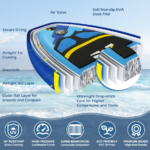
SUP boards have a different structural design from conventional inflatable boat tubes. Many inflatable SUP boards use drop-stitch construction, in which thousands of connecting yarns join the upper and lower fabric layers. When the board is inflated, these yarns help maintain the distance between the two surfaces and create a relatively flat, rigid platform.
TPU drop-stitch fabric is developed for this type of structure. It should not be treated as an ordinary TPU coated textile because its internal yarn arrangement is a defining part of its performance.
How the drop-stitch structure works
A typical drop-stitch construction contains two fabric layers connected by numerous internal yarns. When the chamber is inflated, internal pressure pushes the two outer layers apart. The connecting yarns resist this separation and help control the board’s thickness and shape.
The construction is important because an inflatable SUP board needs more than air retention. It must also maintain its dimensions under the rider’s weight and during movement across the water.
The number, arrangement, material, and strength of the connecting yarns all influence the final structure. The outer fabric layers and TPU coating also need to work with the internal yarn system.
Why dimensional stability matters
If the upper and lower surfaces deform excessively under pressure, the board may lose its intended shape. This can affect stiffness, balance, and the rider’s experience.
A suitable TPU drop-stitch construction should therefore be evaluated for dimensional stability under the specified inflation pressure. The finished board needs testing because fabric specifications alone cannot establish how the complete structure will perform.
The role of TPU coating
The TPU coating contributes to the protective and functional properties of the fabric layers. Depending on the material design, it can support water resistance, airtight construction, and compatible welding processes.
For manufacturers, the key question is whether the coating, base fabric, and internal drop-stitch yarn system have been designed to work together. A standard TPU coated nylon fabric cannot replace a properly engineered drop-stitch construction in a high-pressure SUP board.
How Do You Choose Between TPU Coated Nylon and TPU Drop-Stitch Fabric?
These two material types are used for different structural purposes. TPU coated nylon is a textile material that can be used in inflatable boat tubes, chambers, and other coated fabric components. TPU drop-stitch fabric is designed around a specific internal structure that helps maintain the thickness and shape of an inflatable board or platform.
The choice depends on the product design rather than a simple ranking of material strength.
| 選定のポイント | TPU coated nylon | TPU drop-stitch fabric |
|---|---|---|
| Main construction | Coated woven textile | Two outer layers connected by internal yarns |
| Typical role | Inflatable boat tubes and chambers | Inflatable SUP boards and rigid-style platforms |
| Key requirement | Strength, flexibility, and air retention | Dimensional stability under inflation pressure |
| Material evaluation | Base fabric, coating, and seams | Outer layers, connecting yarns, coating, and structure |
| Manufacturing focus | Panel cutting and compatible joining | Drop-stitch construction and sealing process |
For an inflatable boat, the main fabric selection may focus on the tube’s mechanical requirements and resistance to handling damage. For an inflatable SUP board, the internal drop-stitch structure is central to the product’s shape and stiffness.
Some water sports products may combine different fabric constructions in one design. Manufacturers can use a heavier coated textile in areas that need additional reinforcement while using a specialized drop-stitch material for the main board structure. The exact arrangement depends on the product architecture and production method.
Which TPU Fabric Properties Matter in Marine Environments?
Water sports equipment is exposed to more than water alone. Saltwater, sunlight, temperature changes, repeated folding, and long periods of storage can affect the material.
A suitable TPU fabric for water sports should be evaluated against the actual environmental conditions in which the finished product will operate.
加水分解耐性
Hydrolysis is the chemical breakdown of polymer chains through reaction with water. It can affect certain polyurethane materials, particularly under prolonged exposure to moisture and elevated temperatures.
Polyether-based TPU is commonly considered for applications where hydrolysis resistance is important. This makes it a relevant option for marine and inflatable products that experience frequent water exposure.
However, hydrolysis resistance should be confirmed through appropriate test information. The TPU formulation, coating construction, temperature, and exposure time all influence the result.
Saltwater and chemical exposure
Marine equipment may come into contact with seawater, cleaning agents, oils, sunscreen, and other substances. The effect depends on the chemical involved, its concentration, contact duration, and the specific TPU formulation.
Manufacturers should identify the substances likely to contact the finished product and request compatibility information where necessary. A general statement about marine suitability is not a substitute for testing under relevant conditions.
UV and outdoor aging
Inflatable boats and SUP boards are often stored or used outdoors. Sunlight can gradually affect polymer materials, coatings, and colors.
UV resistance varies by TPU formulation and any stabilizing additives used during production. Manufacturers planning products for extended outdoor exposure should request supporting test data and consider accelerated aging evaluations.
Color retention also deserves attention. Changes in appearance may be especially noticeable on brightly colored marine equipment.
低温での柔軟性
Some water sports products are used in cool weather or stored in environments where temperatures fluctuate. A material that becomes excessively stiff may be more difficult to fold and handle.
Manufacturers should check the specified temperature range and evaluate flexibility under relevant conditions. The actual performance depends on the TPU grade and textile construction, not simply the product name.
How Does High-Frequency Welding Affect Inflatable Boat Fabric Performance?
Joining technology has a direct influence on the reliability of inflatable products. Even when the main fabric has suitable mechanical properties, weak seams can become a failure point under pressure or repeated handling.
High-frequency welding is one joining method used with compatible TPU coated materials. It uses electromagnetic energy to generate heat in suitable thermoplastic layers, allowing the material surfaces to bond under controlled pressure.
Material compatibility comes first
Not every coated fabric has the same welding behavior. TPU formulation, coating thickness, substrate, surface condition, and laminate construction can affect the welding process.
Before mass production, manufacturers should confirm that the selected TPU coated nylon is compatible with the available welding equipment. Sample trials help establish an appropriate processing window.
Welding parameters need to remain consistent
Temperature, pressure, processing time, electrode design, and material positioning all affect seam quality. Incorrect settings can result in incomplete bonding, uneven seams, or damage to the coating.
A production team should establish process parameters for the exact fabric construction and monitor consistency during manufacturing. Parameters developed for one TPU material should not automatically be transferred to another.
Seam strength and air retention require finished-product testing
A welded seam may look uniform but still require mechanical and leakage testing. Manufacturers should evaluate seam strength and inspect the finished inflatable structure under its intended operating conditions.
Testing should include areas around valves, corners, panel intersections, and reinforced sections. These locations may experience different stress levels from the main body of the product.
What Tests Should Manufacturers Request from a TPU Fabric Supplier?
A technical data sheet is a useful starting point when comparing TPU fabric suppliers. It provides information about the material construction and measured performance. However, manufacturers should also consider whether the listed tests match the requirements of the finished product.
The following items are particularly relevant to inflatable boats and SUP boards:
Tensile strength and elongation
Tensile testing measures resistance to pulling forces, while elongation indicates how much the material stretches before breaking. Both values help manufacturers assess how the textile may behave under load.
破れ抵抗
Tear testing helps evaluate how the material responds when a cut or damaged point is subjected to further force. This is important for products exposed to rough handling or contact with hard surfaces.
コーティングの密着性
The coating must remain bonded to the textile substrate. Poor adhesion may lead to separation during folding, handling, or environmental exposure.
Hydrolysis and aging tests
For marine products, testing after moisture exposure and relevant aging conditions can help assess whether the coating maintains its properties over time.
Welding and seam tests
The supplier’s material should be evaluated using the manufacturer’s actual production process. Seam strength and air retention should be checked on finished samples, not inferred from the fabric’s original specifications.
Dimensional and pressure testing
For inflatable SUP boards, the complete drop-stitch structure should be tested at the intended pressure and under representative loads. For inflatable boats, testing should reflect the design pressure, loading conditions, and relevant product safety requirements.
No single fabric test can establish the safety or service life of a finished boat or SUP board. Material data, production controls, structural design, and finished-product testing need to be considered together.
How Should You Evaluate an Inflatable Boat Fabric Supplier?
A supplier’s ability to provide the right material consistently is as important as the initial sample. Manufacturers may need several fabric weights, different coating constructions, customized colors, or specific joining characteristics for one product range.
Several points are worth confirming before placing a production order.
Ask for the exact fabric construction
Request the base fabric type, denier, weave information, coating type, thickness, and total weight. If the application requires polyether TPU, confirm the formulation rather than relying on a general TPU product description.
Review technical data before comparing prices
Two fabrics with similar weight may have different tensile strength, tear resistance, coating adhesion, and welding characteristics. Comparing prices without checking these details can lead to an unsuitable material choice.
Request samples for production trials
A sample should be tested using the same cutting, welding, and assembly process planned for mass production. This is particularly important for high-frequency welding, where small construction differences can affect the processing window.
Discuss customization requirements
Inflatable boat and SUP board manufacturers may require specific fabric weights, coating thicknesses, colors, and roll widths. These requirements should be confirmed before production planning begins.
Check batch consistency and supply arrangements
A material approved during prototype development should remain consistent in subsequent orders. Manufacturers should establish clear specifications and incoming inspection procedures to reduce the risk of differences between production batches.
Choosing the Right TPU Fabric for Your Next Water Sports Product
The right TPU fabric depends on the structure and operating conditions of the finished product. Inflatable boat manufacturers may prioritize tensile strength, tear resistance, abrasion performance, and reliable welded seams. SUP board manufacturers need to pay close attention to drop-stitch construction, dimensional stability, and performance under inflation pressure.
TPU coated 210D, 420D, and 840D nylon fabrics offer different construction options for marine and inflatable applications. TPU drop-stitch fabric serves a more specialized role in inflatable boards and platforms. Comparing these materials requires more than looking at denier or fabric weight; coating properties, textile structure, processing compatibility, and test results all matter.
Xianglong Polymer Fabric provides TPU coated nylon and polyester fabrics, along with specialized TPU drop-stitch materials for technical inflatable applications. Manufacturers can discuss their required substrate, fabric weight, coating construction, and performance specifications when evaluating material options for inflatable boats, SUP boards, and other water sports products.
A well-matched fabric construction gives the production team a more reliable starting point. Final performance still depends on the complete product design, manufacturing process, and verification under the conditions the equipment is expected to face.