Rethinking Water Storage in the Field
Traditional rigid containers work well in controlled environments, but they quickly become inefficient in mobile or remote scenarios.
They take up fixed space, are difficult to transport when empty, and offer little flexibility in deployment.
Flexible water storage systems solve these problems—but only if the material can handle the demands of real use.
This fabric is developed specifically for that purpose: enabling large-capacity water storage without the limitations of rigid structures.
What Makes Liquid Containment Different
Designing for water storage is not the same as designing for dry storage.
Water behaves as a moving load. It shifts, impacts internal surfaces, and continuously redistributes pressure.
In practical terms, this means the material must handle:
Constant internal movement (sloshing)
Localized stress from shifting weight
Continuous tensile load from gravity
Pressure variations during filling and use
The 500D polyester base provides the structural support needed to manage these forces without excessive deformation.
Why Seam Integrity Matters More Than Surface Waterproofing
In water storage applications, most failures do not occur on the surface—they occur at the seams.
Even a small leak can compromise the entire system.
That’s why this fabric is designed for high-frequency (HF) welding rather than traditional stitching.
The TPU layer enables:
Seamless bonding without needle holes
Consistent, repeatable sealing performance
Strong joints that hold under continuous load
This approach ensures the containment system remains reliable over time, even under heavy use.
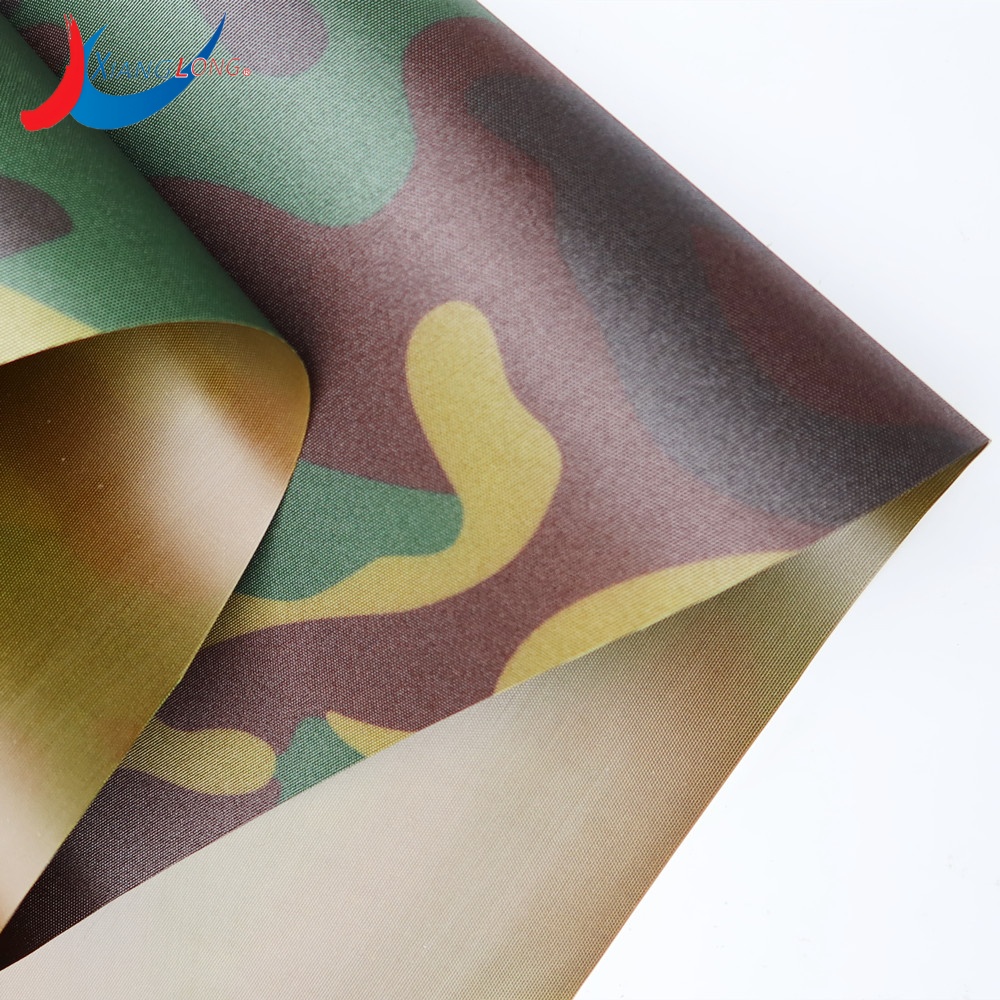
Camouflage as a Functional Feature
The camouflage finish is not just visual styling.
In many field applications, reducing visibility is part of the functional requirement:
Blending into natural environments
Avoiding unnecessary attention in remote locations
Supporting tactical or wildlife-related operations
It also helps the product visually integrate into outdoor setups, rather than standing out.
Transport Efficiency and Deployment Flexibility
One of the key advantages of flexible storage systems is how they behave when not in use.
This material allows for:
Folding into compact volumes when empty
Easy transport in vehicles or packs
Rapid deployment when water access is needed
Compared to rigid tanks, this significantly improves logistics efficiency, especially in remote or temporary setups.
Material Structure (Overview)
500D polyester base provides structural strength and abrasion resistance
TPU inner layer ensures waterproof and airtight performance
Composite construction balances flexibility with load-bearing capability
The structure is optimized for containment rather than general-purpose fabric use.